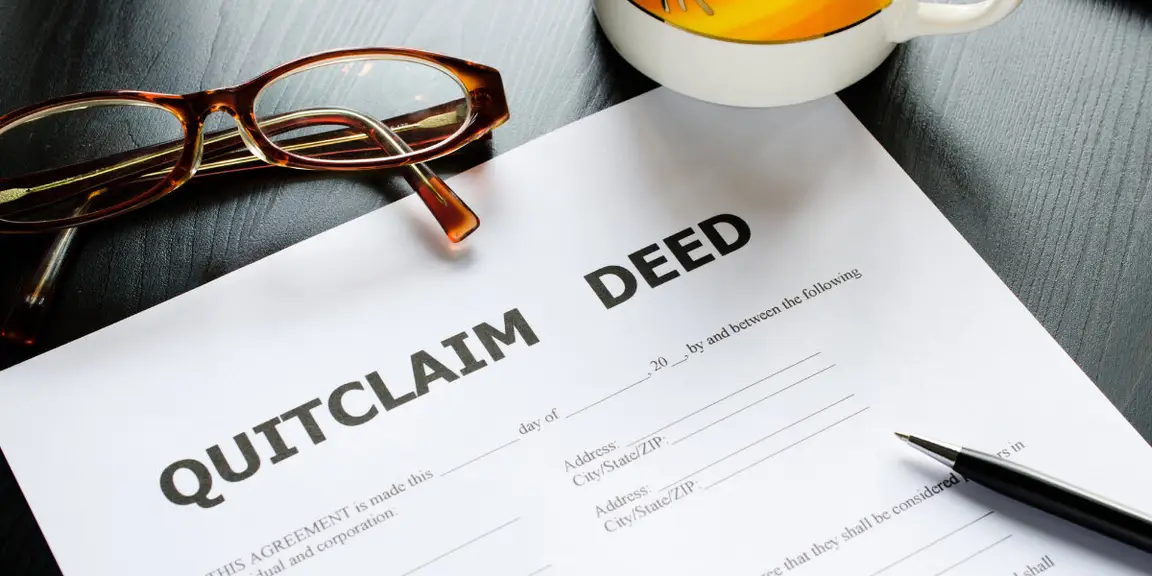


One seller learned this the hard way after her brother signed over the family place in Pasadena, recorded everything at the county clerk, and waited two years before trying to list it. The buyer’s lender pulled title, found the quitclaim deed sitting in the chain, and the sale fell apart in about nine days. She’d done everything the internet told her to do. The rules the internet assumes just don’t apply to Texas.
What Does a Quitclaim Deed Do in Texas?
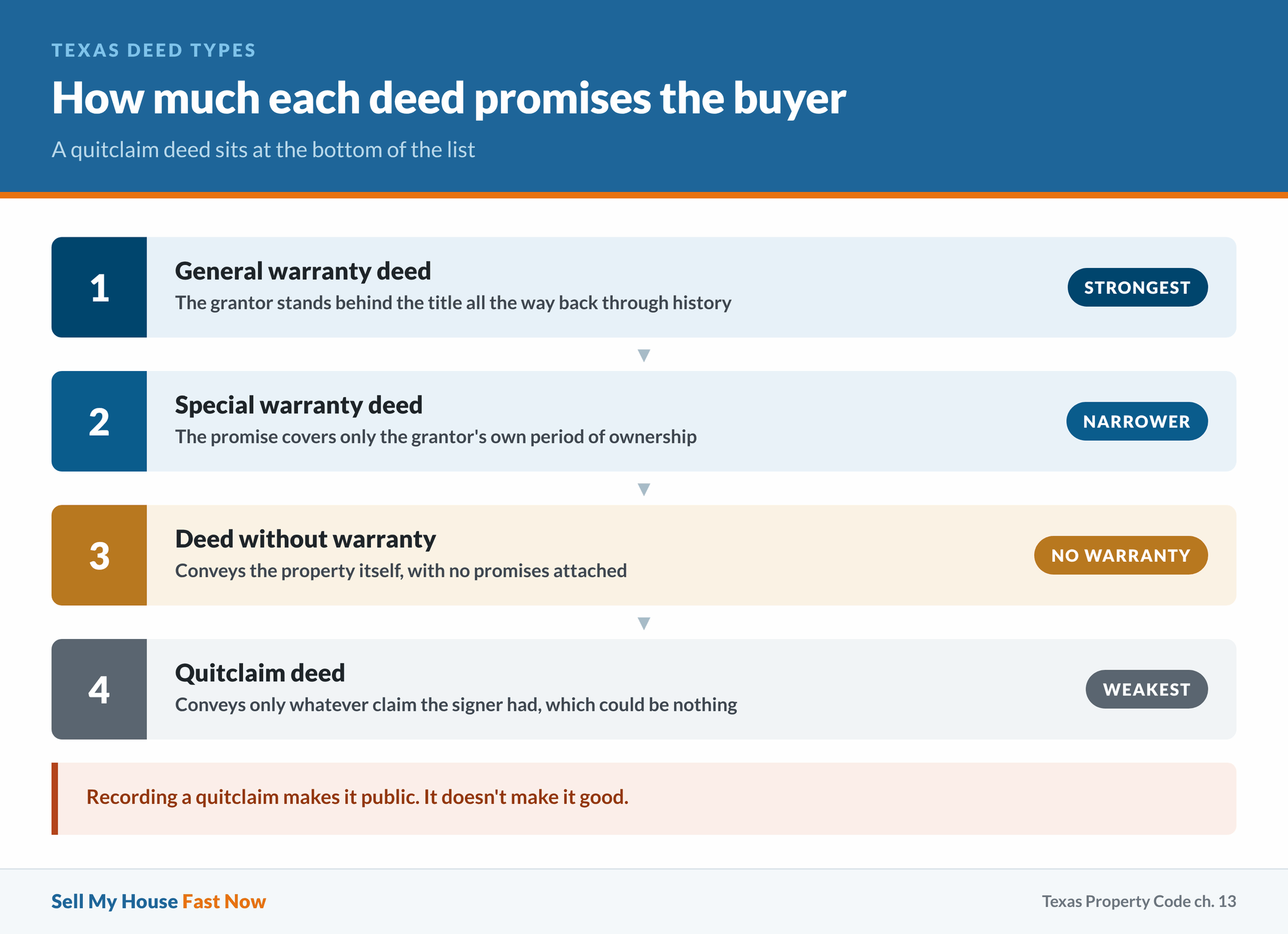
Sign it, notarize it, record it at the courthouse, and the house is yours. That’s the reasonable belief, and it falls apart the moment a title examiner looks at the file. In Texas, a quitclaim deed doesn’t actually transfer the property, it transfers whatever claim the signer might have had, which could be full ownership or absolutely nothing at all.
Set that against a warranty deed. A general warranty deed makes the grantor stand behind the title all the way back through history. With a special warranty deed, that promise narrows to the grantor’s own period of ownership. A quitclaim gives a buyer a shrug on paper.
Compared to many other states, Texas law is stricter in how it treats the person receiving one. A recipient here is deemed to have constructive notice of every title defect, including unrecorded claims.
The recording side works like any other instrument. Under Section 13.001 of the Texas Property Code, an unrecorded conveyance is void as to a creditor or a later buyer who pays value without notice. It’s still binding on the parties themselves and their heirs. You can read the recording rules in Chapter 13 of the Property Code for yourself.
Recording it makes the quitclaim public. It doesn’t make it good.
How Do Texas Homeowners End Up with a Quitclaimed Property?
For years I told sellers a recorded deed meant a clean transfer, and I was wrong about that in Texas specifically. Most of the situations I run into weren’t anybody’s fault. They were cheap, fast fixes that nobody revisited for a decade.
Divorce drives a lot of it. One spouse keeps the house, the other signs away their interest using a form pulled off a template site, and the decree gets filed, so the paperwork looks finished even though it isn’t. Those generic online divorce transfer forms usually produce a quitclaim deed, and Texas title companies often reject them.
Inheritance is the other big engine. A parent dies in Beaumont or Lubbock, siblings agree one of them should take the house, and somebody signs it over the kitchen table. Problem is, under Texas law the property already vested in the heirs at the moment of death, and the deed records don’t update on their own. An affidavit of heirship doesn’t itself transfer title; filing it is only the first step, and the heirs still need a deed signed by all of them to complete a sale. TexasLawHelp walks through those non-probate paths step by step.
A while back I got a call from an out-of-state heir whose mother’s house sat in Mesquite, three payments behind, with an auction date already posted. Her uncle had quitclaimed his share to her six years earlier, and she had no idea that single page was the thing standing between her and a closing.
Rounding out the list: adding an adult child to the property title, moving a house into a revocable trust, and settling an old boundary dispute with a neighbor. Each one can freeze a sale years later.
When Should You Use a Quitclaim Deed in Texas?
A landlord in Waco called me about a rent house he’d owned since the nineties. He was worried that an old lien release had never been filed correctly. His question was whether such a deed from the long-gone lienholder would clean it up.
There’s almost no situation in Texas where it’s the right tool. The better tool is a deed without warranty, which does the same job without creating title problems.
What’s the difference? A deed without warranty conveys the property itself, where a quitclaim conveys only the grantor’s claim. Because of that distinction, most Texas title companies will insure a chain containing a deed without warranty but balk at a quitclaim. Researchers at Texas A&M’s Real Estate Research Center explain how a quitclaim affects later buyers.
The narrow cases where it does no harm share one feature: nobody involved will ever need title insurance. Transfers between closely related parties who fully trust each other and don’t require insurance, or clearing a small defect inside a family, are about the extent of it.
If a Texas attorney hands you one for residential property, ask why.
Texas is genuinely different here. The same document that’s routine in some neighboring states behaves like a contaminant in Texas deed records, and a lot of out-of-state advice ignores that.
What Title Problems Come with a Quitclaim Deed?
“Can’t the title company just make an exception for mine?”
They can, but they usually won’t, and asking won’t change the underwriting math. Many title insurers balk at a quitclaim anywhere in the chain of title, not just in the current owner’s deed. A recent one is the hardest to get past.
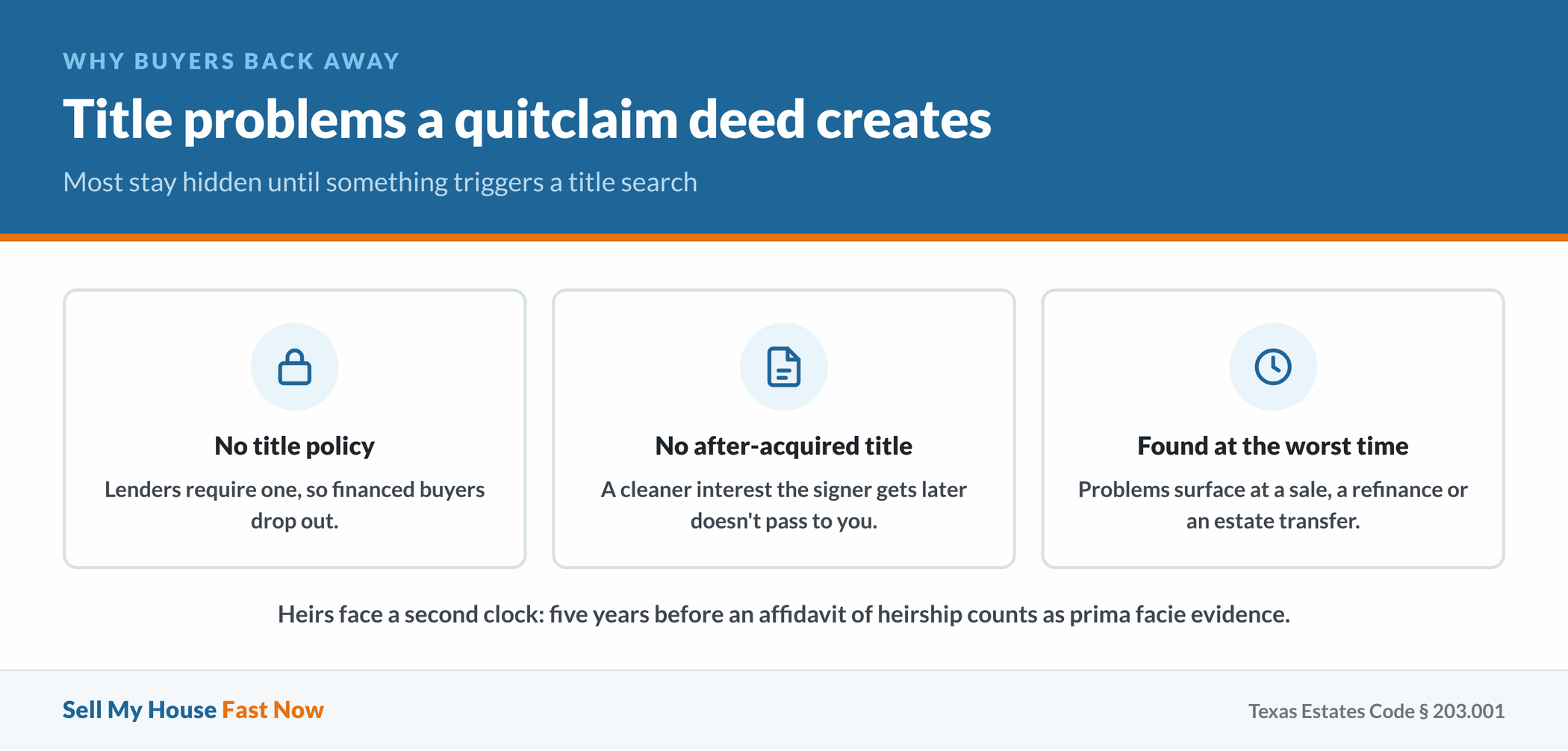
No title policy means no conventional buyer, since lenders require one and so do cash buyers who care about resale. The pool of people who can close on your house shrinks to those willing to accept the risk personally, which is a very short list in any Texas market.
Then there’s the after-acquired title gap. Quitclaim deeds in Texas generally do not pass after-acquired title. If the person who signed yours later obtained a cleaner interest in the same property, that interest didn’t flow through to you automatically the way it would under a warranty deed.
These issues hibernate. Quitclaim deed problems typically stay invisible until something triggers a title search, whether that’s a sale, a refinance, or an estate transfer. That’s why so many owners find out at the worst moment, often with a moving truck already booked.
Heirs face a second clock. Under Texas Estates Code Section 203.001, an affidavit of heirship only becomes prima facie evidence of the facts it states after it’s been on file for five years. Pair that waiting period with a quitclaim deed and a title officer has two reasons to pass.
Can I Sell a House with a Quitclaim Deed in Texas?
“My name’s on the deed records, the taxes come to me, so of course I can sell it.” I hear that constantly. The tax assessor’s mailing list isn’t the same thing as marketable title. Yes, you can sell a house in Texas that came to you by quitclaim deed. Who can afford to buy it and what it costs to get there matters most.
There are basically three paths. You cure the defect before listing, you sell to a buyer who doesn’t need title insurance, or you sell at a price that reflects the cloud. Sellers in Texas pick one of those whether they realize it or not.
The usual cure is a special warranty deed or a deed without warranty from the original grantor. It gets hard when that grantor died years ago and left four children, since every heir must sign.
People weigh timing less than it matters. Texas homes aren’t moving quickly: the median listing in the state sat 66 days on the market in September 2026, according to Realtor.com data from the St. Louis Fed. Add a title cure on top of a two-month marketing window and you’re looking at a long stretch of carrying costs on a house you’ve already decided to leave.
Companies like Sell My House Fast Now handle clouded Texas titles routinely, and knowing what a quitclaimed property fetches as-is helps you decide whether chasing a cure is worth the months.
How Do You Sell a Texas House Transferred by Quitclaim Deed?
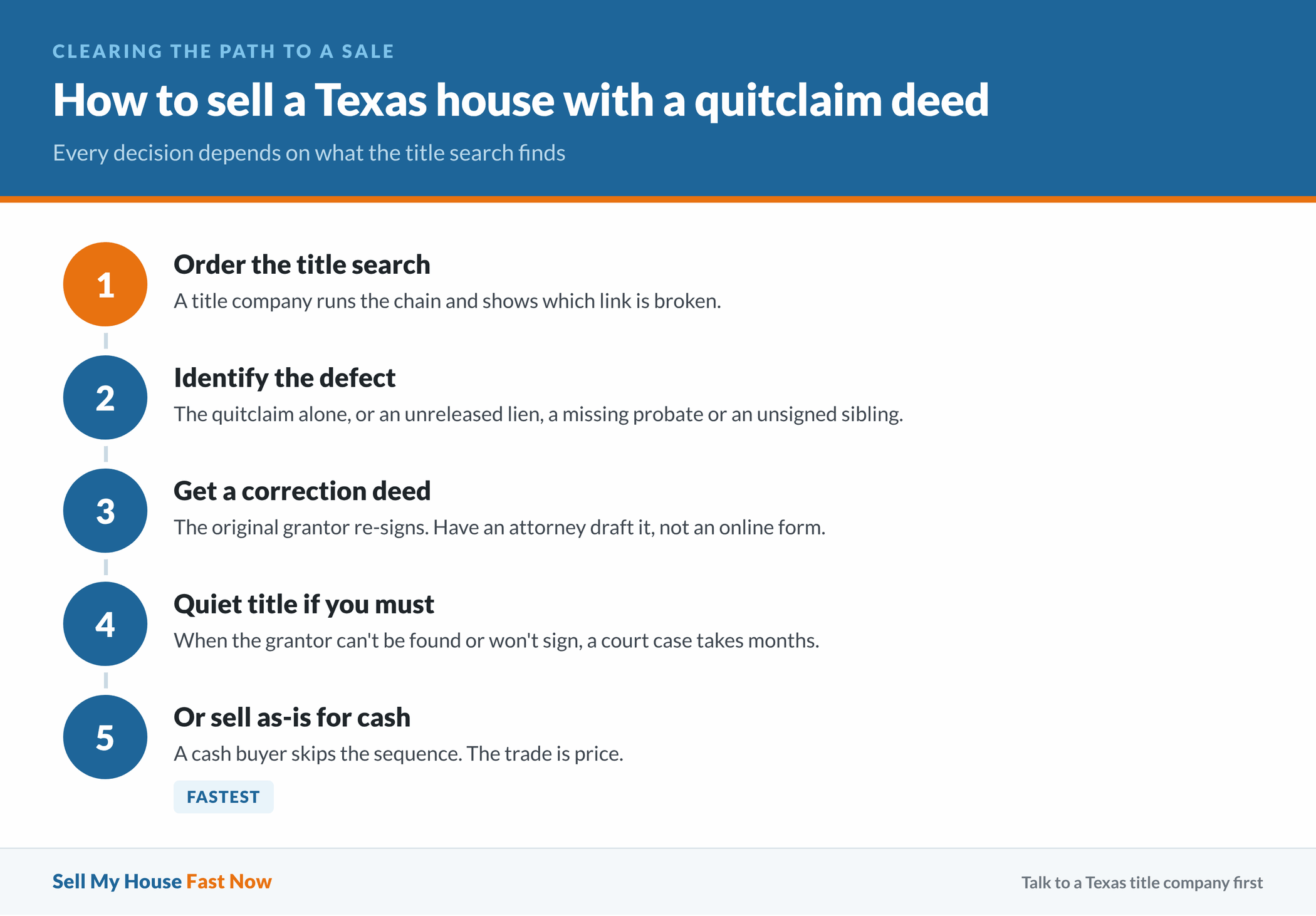
Order the title search before you do anything else, because every decision downstream depends on what it finds.
Any title company will run the chain and tell you precisely which link is broken. Maybe the quitclaim deed is the only problem. Or it’s sitting on top of an unreleased lien, a missing probate, or a sibling who never signed anything.
Once you know the defect, the correction deed is usually the cheapest fix available. Getting the original grantor to re-sign costs a few hundred dollars and a notary. Having an attorney draft the replacement deed beats using an online form, which tends to produce another true quitclaim carrying all the same title insurance problems.
When the grantor can’t be found or won’t cooperate, you’re into a suit to quiet title. That’s a court proceeding, and it takes months, running real legal money in the Texas counties I work in. Rarely worth it on a tired rental in a $150,000 neighborhood.
Heirs have a parallel track. Texas Estates Code 101.001 provides that title vests immediately in the heirs at death, subject to estate debts, so the paperwork is about proving what already happened. Have you confirmed every heir who might hold a sliver of that property?
Selling as-is to a cash buyer skips the whole sequence. The trade is price, and that’s an honest trade rather than a trick.
What Questions Should You Ask a Title Company About a Quitclaim Deed?
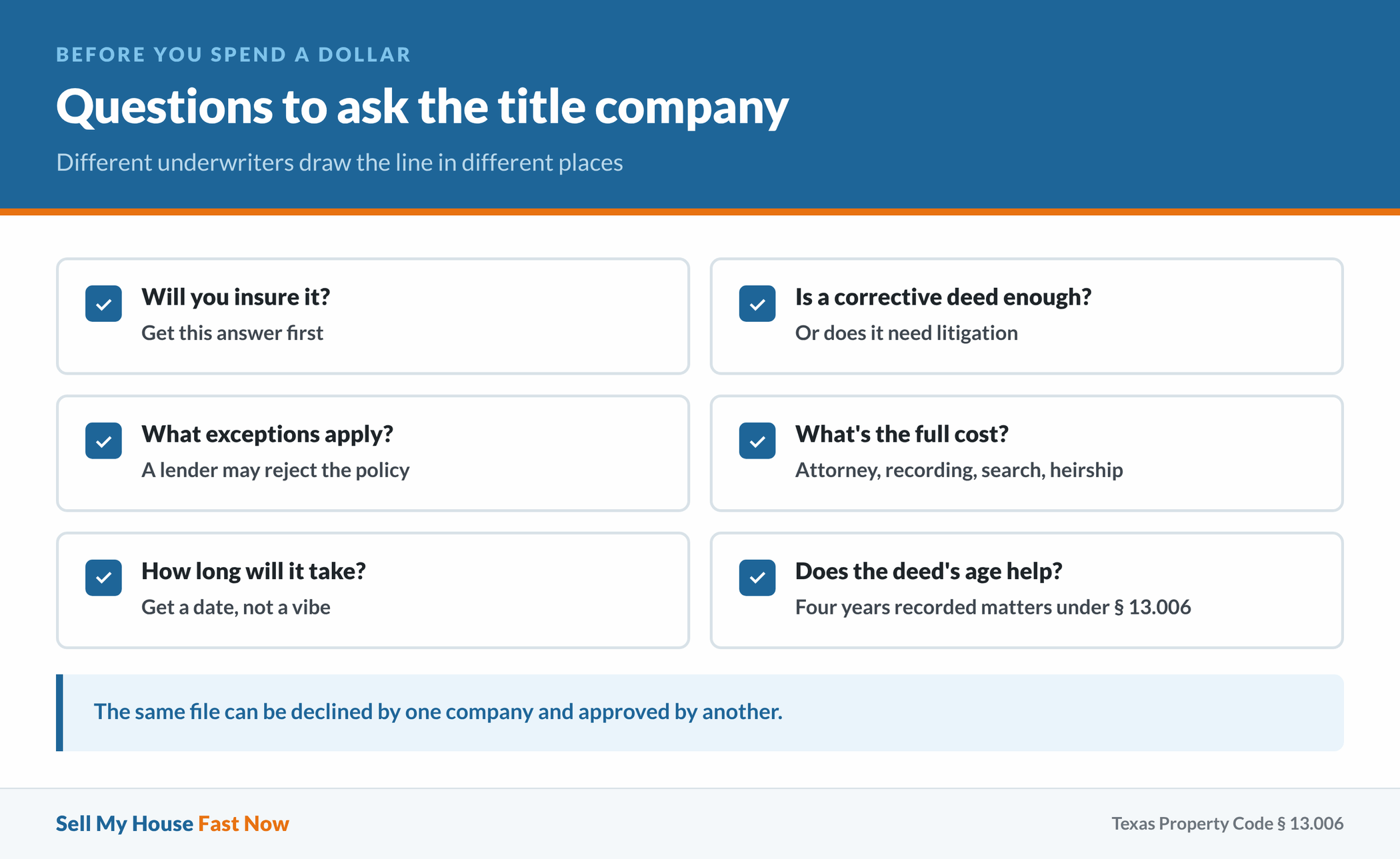
Picture an heir who quitclaimed her share to a sibling fifteen years ago and now wants to sell. In Texas, a quitclaim deed never drops out of the chain. Age does matter, though. Under Property Code § 13.006, a quitclaim recorded for four years no longer counts as notice of unrecorded claims to a later buyer, so tell the title company how old yours is.
Start by asking whether the company will insure the title at all, and get that answer before you spend a dollar on anything else. Some Texas title companies will issue a policy if you provide additional documentation or complete corrective steps first.
Next question: will the underwriter accept a corrective deed from the original grantor, or does this require litigation? Different Texas underwriters draw that line in different places. I’ve watched the same file get declined by one company and approved by another a week later with identical paperwork.
Ask what exceptions will appear on the policy. A title company might insure around the quitclaim while carving out the specific risk it created, and a buyer’s lender may reject the policy on that basis alone.
Price the whole thing. Attorney fees, recording costs, the title search, and any heirship work all stack. Each Texas county clerk sets its own recording fees, so call yours for the current figure rather than trusting a national website.
Finally, ask how long. Title companies in Houston and San Antonio quote wildly different turnaround times depending on their backlog. Get a date, not a vibe.
Is a Cash Buyer the Best Option for a Quitclaimed House?
Houston’s median single-family price fell 3.0% to $320,000 in October 2026, according to the Houston Association of Realtors. Homes averaged 59 days to sell, unchanged from a year earlier. In a slow market, a quitclaim in the chain is one more thing a buyer wants explained.
Dallas held steadier. Redfin put the city’s median sale price near $449,000 for the three months ending August 2026, nearly unchanged from a year earlier. Even there, title defects don’t get a pass from underwriters.
Cash buyers work because they’re absorbing the risk a title insurer won’t. We buy the house knowing the quitclaim deed is there, and we handle the cure on our own time and our own dime.
Is it the best option? Not always. If your grantor is alive, reachable, and willing to sign a corrective deed next week, fix it and list it. You’ll net more. If the signer passed away, though, the heirs are scattered across three states, and your carrying costs are stacking up every month, the arithmetic flips fast.
An owner in Killeen had been quietly covering two mortgages for close to a year before she called us. She’d moved for a job and kept the old house because a quitclaim deed from her ex-husband made it unlistable, and she never told her family about the second payment. We closed in under three weeks and took the title problem with us.
For a read on your situation from the buyer’s side, Sell My House Fast Now will look at a property with a quitclaim deed in the chain and tell you straight whether it’s fixable.
Frequently Asked Questions About Selling a House with a Quitclaim Deed in Texas
Can You Get a Mortgage on a Property That Came to You by Quitclaim Deed?
It’s difficult in Texas, because nearly every lender requires a title insurance policy before funding, and that’s the exact thing a quitclaim in the chain blocks. Some borrowers get approved after executing a corrective deed or completing a quiet title action first. Talk to a Texas lender early so you know which hurdle you’re facing before you fall in love with a rate.
What Exactly Is a Quitclaim Deed Under Texas Law?
It’s a signed, notarized document in which one person releases whatever interest they may hold in a Texas property to another person, with zero promises attached. Nothing in it claims the signer owned anything. Texas courts recognize it as a valid instrument, but Texas title companies treat it as having conveyed nothing for underwriting purposes, which is why its practical usefulness here is so limited.
What Makes a Quitclaim Deed Invalid in Texas?
A Texas deed generally has to be in writing, identify the grantor and grantee, describe the property adequately, be signed by the grantor, and be delivered and accepted. Missing a proper notary acknowledgment won’t void it between the two parties. It will keep the county clerk from recording it, though, which leaves you exposed to a later buyer under the recording statute discussed above. Fraud, forgery, or a grantor who lacked capacity can also undo one entirely.
What Does a Quitclaim Deed Accomplish in a Texas Divorce Settlement?
It removes one spouse’s name from the property records, and in Texas that’s about all it does well. Family law attorneys here steer clients toward a special warranty deed instead, because the quitclaim version frequently leaves the spouse who keeps the house unable to refinance or sell at full value. If your decree already called for a quitclaim deed, you can usually go back and have a proper deed signed, assuming your ex-spouse cooperates.
Does Recording a Quitclaim Deed at the County Clerk Make It Stronger?
Recording puts the world on notice and establishes your priority against later buyers, so yes, it protects you in that specific way. What it doesn’t do is improve the quality of what you received. A recorded quitclaim is still a quitclaim, and a Texas title examiner will flag it years from now, though its age matters under the four-year rule covered above.
Quitclaimed Houses in Dallas and Across Texas
Most houses we buy sit in the Metroplex, where listings took a median of 62 days to sell in October 2026, per Realtor.com. With a quitclaim deed in the chain, a local Dallas buyer can skip that wait.
We also buy houses across Texas.
Get a Cash Offer for Your Texas House
Maybe you’re sitting on a Texas house with a quitclaim deed in its history and can’t decide whether to fix it or sell it as-is. We’re happy to walk through both paths with you. No pressure, no obligation, and no hard feelings if you decide the repair route makes more sense for your family. Contact Sell My House Fast Now or use the form below.