


The lawyer’s bill almost never comes out of your own checking account. Probate attorney fees in Texas are paid from the estate itself, and the law spells that out plainly. If the house is the estate’s only real asset, every dollar of probate attorney fees comes straight out of what the heirs eventually split.
I’ve bought a lot of inherited houses across Texas, and the money question comes up before the house question almost every time.
What Does Probate Cost in Texas?
A daughter who inherited her father’s house in Houston told me she assumed Texas would take a fixed cut, like she’d heard happens elsewhere. It doesn’t. Some states set probate attorney fees with a percentage schedule written into law. Here, a lawyer can’t bill you a fixed slice of the estate just because a statute says so, because no such statute exists. Instead the standard is reasonableness, and reasonableness in Texas gets measured against time, complexity, and results.
Travis County charges $360 for an application to probate a will with issuance of letters testamentary, according to the Travis County Clerk’s probate fee page. The same fee applies there to a muniment of title application or an application to appoint an administrator. Your own county clerk sets its own schedule, so call and confirm before you budget.
Even a straightforward uncontested administration runs into the thousands; a contested one runs into whatever the fight costs.
Add appraisal fees if the estate needs a formal valuation. Then come recording fees when the deed transfers, plus the cost of maintaining a vacant Texas house through a summer, because insurance, utilities, and lawn service don’t pause for the courthouse calendar.
Her family listed it twice. Two agents, two expired listings, zero offers, and a Saturday morning phone call where she told me the AC had quit again and they were done.
What pushed their total cost up wasn’t the lawyer. It was eleven months of carrying a house nobody bought. Families in Texas often get this arithmetic wrong: these fees are a line item you can quote, but holding costs are a meter that runs.
How Are Texas Probate Attorney Fees Calculated?
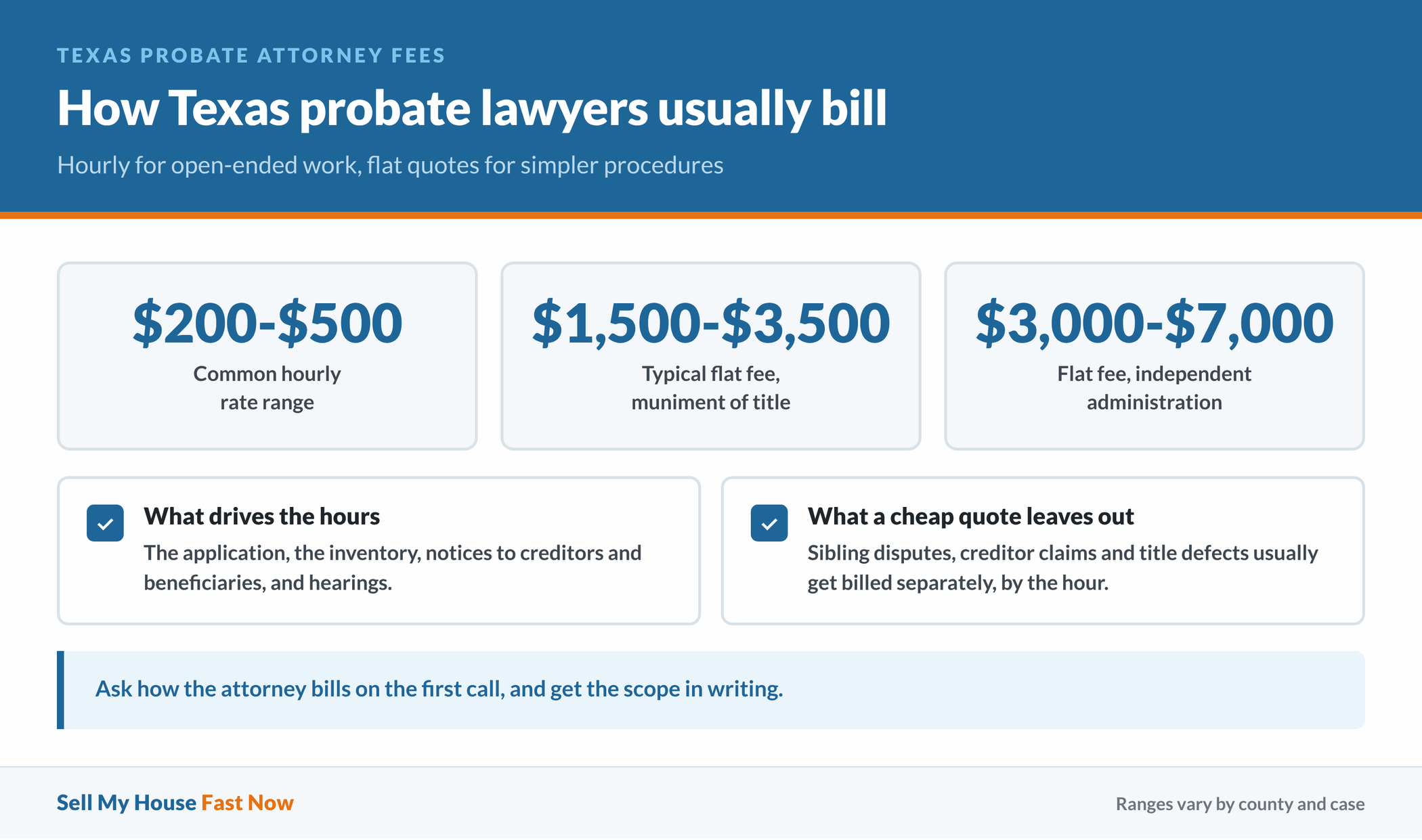
A $5,000 flat fee or a $350 hourly rate can mean very different outcomes for your estate. Ask the attorney how they bill on the first call.
Most probate attorneys in Texas work one of two ways: an hourly rate or a flat quote for a defined scope. Hourly rates across Texas probate practices commonly fall between $200 and $500, depending on the attorney’s experience and where the practice sits.
Flat quotes dominate the simpler procedures. For a muniment of title, flat fees of roughly $1,500 to $3,500 are typical, with independent administration landing somewhere around $3,000 to $7,000.
What actually drives the number? Documents, mostly, including the application, the inventory, and notices to creditors and beneficiaries, along with hearings, which in Harris County and Dallas County can mean waiting on a crowded probate docket. Every one of those steps costs attorney hours, and the fees scale with the hours.
Some Texas lawyers bill paralegal work at a lower rate and pass that savings along. Ask about that too.
Reasonable attorney’s fees necessarily incurred in the proceedings are payable from the estate, and the court can review whether the amount was justified. It’s not a rubber stamp. Beneficiaries who think the fees are out of line can object, and a Texas probate judge has authority to cut them.
One pattern I keep seeing: families shop three firms for a quote and then pick the cheapest without asking what’s excluded. They end up comparing numbers that don’t measure the same scope of work. The cheapest quote rarely covers a dispute with a sibling, a creditor claim, or a title defect that surfaces when the house goes under contract. Those get billed separately, hourly, and that’s where they quietly double in Texas.
What Factors Raise or Lower Probate Attorney Fees in Texas?
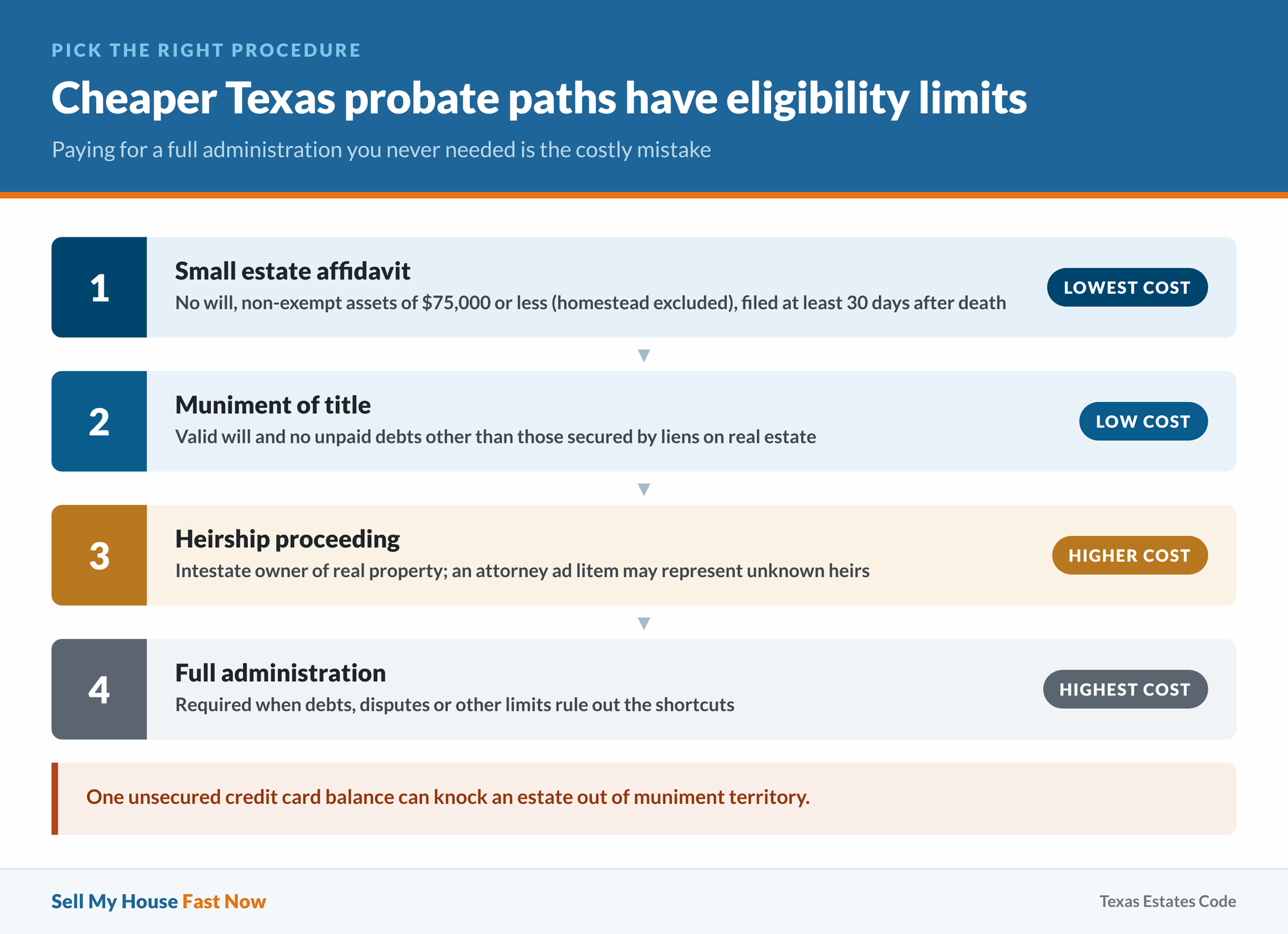
Pick the wrong procedure and you pay for a full administration you never needed. Texas families lose thousands due to that mistake.
The state offers several paths, and the cheap ones have real eligibility limits. A small estate affidavit works only when the decedent died without a will and non-exempt assets total $75,000 or less, excluding the homestead and other exempt property. Inventory the assets carefully before counting on this option. At least 30 days must pass after the death before filing. Muniment of title requires a valid will and no unpaid debts other than those secured by liens on real estate.
Debt is the usual disqualifier. One unsecured credit card balance can knock an estate out of muniment territory and into a full administration, with attorney fees that reflect the difference.
A clean estate where three siblings agree on everything moves through a Texas probate court on a predictable schedule. Add one heir who won’t sign, and you’ve bought yourself litigation, mediation, possibly a mediator’s fee on top of the lawyers.
Heirship determinations raise costs too. When someone dies intestate in Texas and owns real property, the court often needs an heirship proceeding with an attorney ad litem appointed to represent unknown heirs.
Families underestimate how much timing matters. Under Texas Estates Code § 256.003, a will has to be offered for probate within four years of death. After that anniversary, a court may still admit it only if the applicant proves they weren’t “in default,” meaning the delay wasn’t their own neglect. You can read the statute itself on the Texas Legislature’s Estates Code page. Proving you weren’t in default takes attorney work. Filing on time doesn’t.
Property condition quietly affects these costs as well. A house with a cloudy title, an old unreleased lien, or a boundary problem pulls the lawyer into curative work nobody quoted.
Is Hourly or Flat-rate Pricing Better for Probate Attorney Fees?
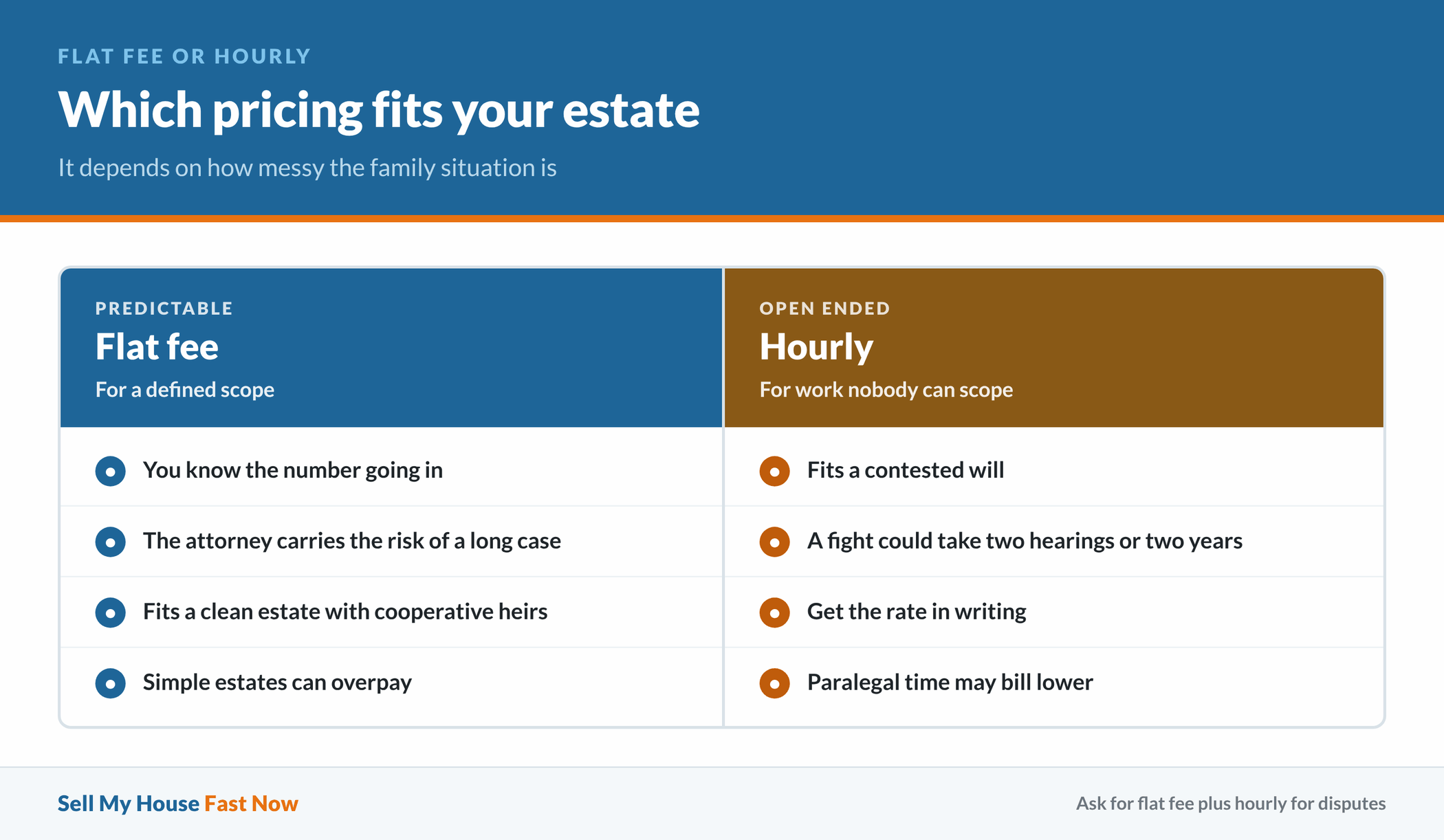
Which wins, a fixed quote or an open-ended bill? The answer depends on how messy your family is.
Flat-rate pricing shifts risk to the attorney. They’ve estimated the hours, and if the case runs long, that’s their problem. For a clean Texas estate with one house, one bank account, and cooperative heirs, I’d take the flat quote every time. You know the number going in, and the number doesn’t move.
Hourly makes sense when the scope genuinely can’t be predicted. A contested will in a Bexar County probate court could resolve in two hearings or consume two years. No honest Texas attorney flat-quotes that.
My mild disagreement with conventional advice: a flat fee isn’t automatically the better choice. I’ve watched families pay a flat rate for a procedure that took the lawyer four hours, so simple estates sometimes overpay under flat pricing, and nobody mentions that when the engagement letter gets signed.
Read the scope language carefully. A good flat-fee agreement in Texas lists exactly what’s included and names the hourly rate that kicks in when something falls outside. Vague ones just say “probate” and leave the rest to argument.
Flat fee for the administration, hourly for anything contested. Plenty of Texas probate lawyers will structure it that way if you ask, and asking costs nothing.
Get it in writing, even if it’s just an email.
For an estate selling a house, one more question belongs in that first conversation: does the quote include reviewing the sales contract and the closing documents? Some firms in Texas fold that in, while others treat the real estate side as separate work.
Who Pays Probate Attorney Fees in Texas?
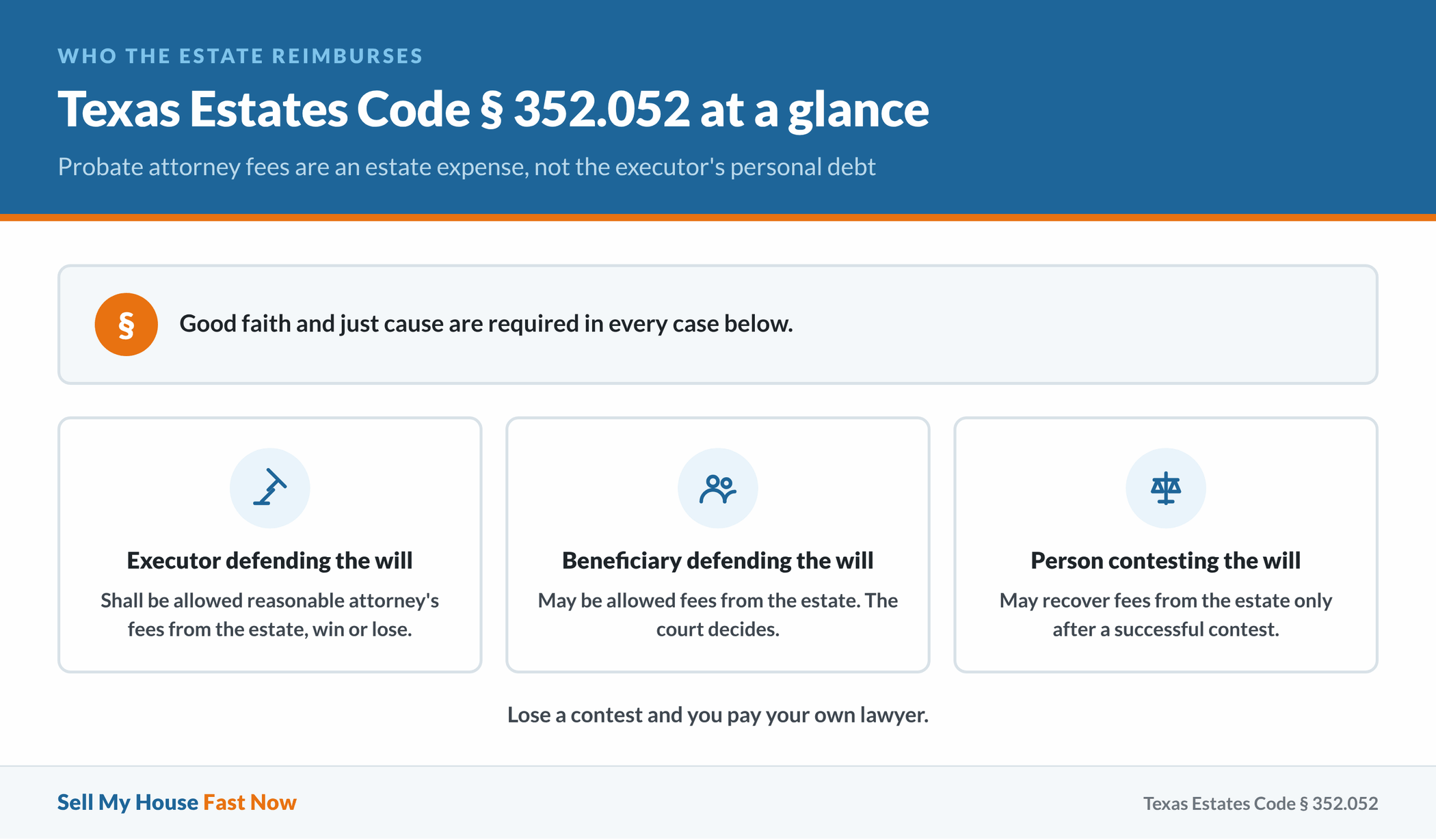
A widow in Tyler called me convinced she personally owed her lawyer a hefty sum. After we walked through it, she understood the estate owed it, and the house sale would cover it at closing.
That’s the general rule across Texas. These fees are an administration expense paid from estate assets, not a personal debt of the executor. Under Texas law the estate covers an executor’s reasonable attorney fees and litigation costs when the executor acts in good faith on behalf of the estate.
The statute gets specific about will fights. A person named as executor may defend a will in good faith and with just cause, whether or not successful. That person shall be allowed necessary expenses and disbursements out of the estate, including reasonable attorney’s fees. You can read § 352.052 directly on FindLaw’s Texas Estates Code page. Losing doesn’t strip the executor of that reimbursement, as long as good faith holds.
Beneficiaries are treated differently. A devisee or beneficiary who defends the will in good faith may be allowed their expenses and attorney’s fees from the estate. May, not shall. That single word is the difference between reimbursement and writing your own check.
Contestants get the narrowest path. An interested person who successfully prosecutes a good-faith contest to a will’s validity may be allowed necessary expenses and reasonable attorney’s fees out of the estate. Lose that contest in a Texas courtroom and you fund your own lawyer.
Who writes the check when the estate has no cash? Usually nobody, until the house sells.
Practically speaking, in Texas estates where an inherited house is the main asset, probate attorney fees get settled out of sale proceeds at the title company. The lawyer’s statement comes in, it’s paid from closing funds, and the heirs split what’s left.
What Happens If the Estate Can’t Cover Probate Attorney Fees?
Which raises the obvious problem: an estate that’s house-rich and cash-poor can’t pay anybody until the house sells. Texas families hit this wall constantly.
The attorney still needs a retainer to start. Taxes keep coming due.
Heirs usually advance the money. One sibling floats the retainer, keeps receipts, and gets reimbursed from the estate at closing. Document it. Any sibling who advances $4,000 across three separate payments should have three receipts and an email trail, because memories get selective when the proceeds get divided.
Some Texas probate attorneys will defer part of their fee until the property sells, especially when the equity is obvious. Not all will.
Creditors have priority rules, too. Administration expenses including probate attorney fees generally get paid before general unsecured claims, so the lawyer isn’t last in line.
Selling the property is often the move that unlocks everything else. Once a Texas house converts to cash, the probate attorney fees get paid, the creditors get satisfied, and the estate can close.
Market timing matters too. In October 2026, the City of Austin’s median sales price was $550,000 with 5.7 months of inventory, per Unlock MLS. Statewide, the median listing sat 66 days on the market in September 2026, according to Realtor.com data from the St. Louis Fed. Add a financed buyer’s 30 to 40 day close, and that’s three months or more of carrying costs before a dollar reaches the estate. Families watching that math sometimes sell direct instead, and a buyer like Sell My House Fast Now can close on the estate’s timeline rather than a lender’s.
Can Heirs Avoid Paying Probate Attorney Fees in Texas?
Plenty of families walk in believing they’ll handle it all themselves and skip the lawyer. Texas probate courts, though, generally require an executor or administrator to have an attorney, because that person acts for the beneficiaries and creditors, not just themselves. Self-representation is generally limited to pro se filings on your own behalf.
There are legitimate ways to shrink the legal bill, though.
Choosing the cheapest qualifying procedure is the biggest lever. A muniment of title involves one application and one short hearing, so it often wraps up in 30 to 60 days. An uncontested muniment costs a fraction of a full administration, since it’s mostly the county filing fee plus a few hours of attorney time. On houses I’ve bought, I’ve seen that gap decide whether an heir even bothers pursuing the property.
Avoiding probate altogether beats reducing probate attorney fees. State law allows transfer on death deeds for real property, and a properly recorded one moves the house to a named beneficiary without court involvement.
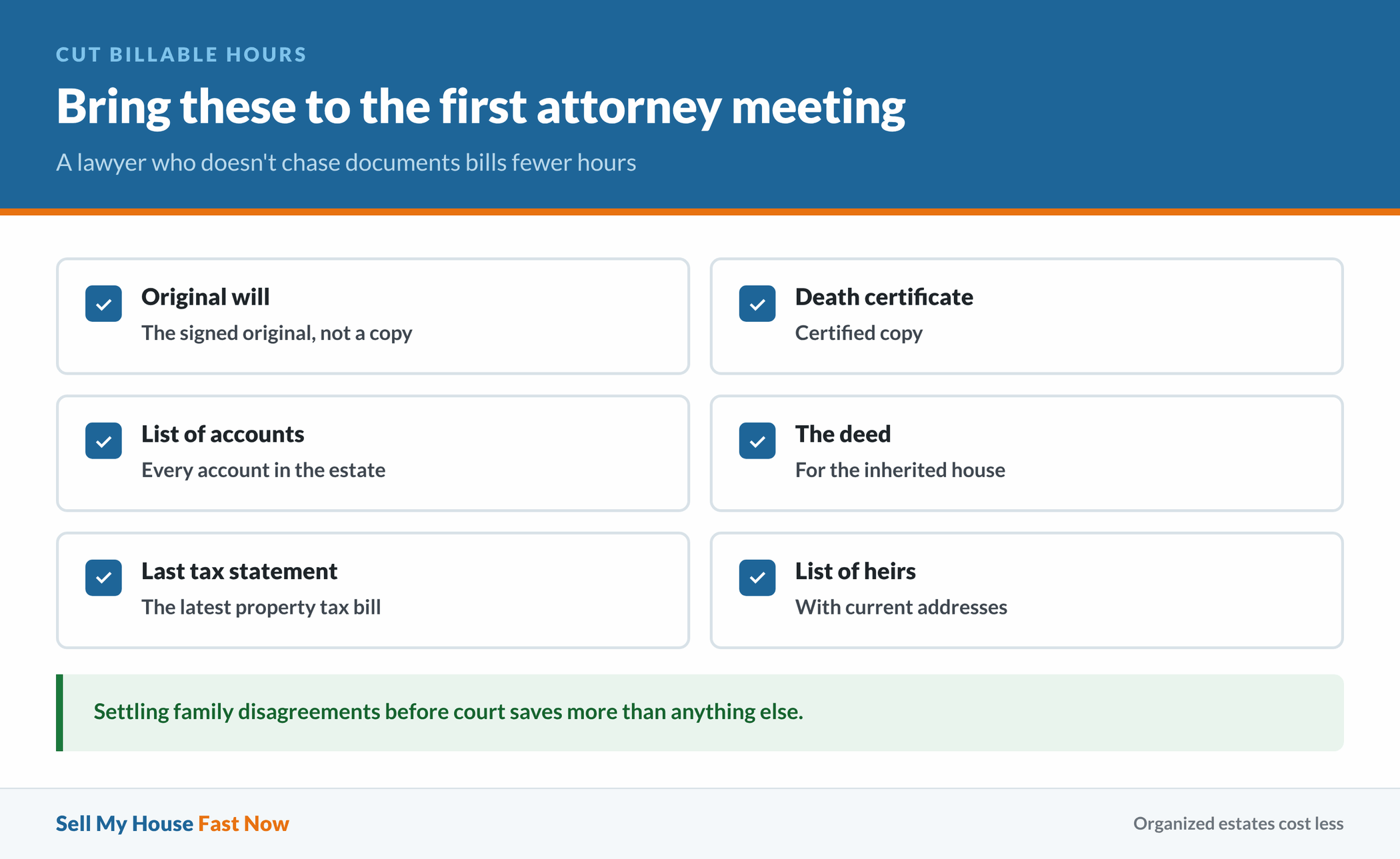
Being organized cuts hours. Show up with the original will, a death certificate, a list of accounts, the deed, the last tax statement, and a written list of heirs with current addresses. An attorney who doesn’t have to chase documents bills fewer of them.
Settling family disagreements before they reach a Texas courtroom saves more than anything else on this list. Mediation costs money. Litigation costs multiples of mediation. Two siblings arguing over a Fort Worth bungalow can burn more in legal bills than the disputed difference in their shares.
A family in Seguin called me about a house their parents had owned since the seventies. It was packed floor to ceiling with thirty years of accumulation. This included a garage with four non-running lawnmowers and a wall of mason jars. We bought it as-is with everything still in it, so the estate’s lawyer got paid at closing without anybody renting a dumpster.
Selling as-is shrinks everything around it: the repairs, the staging, the holding months, the arguments about whose turn it is to drive down and mow.
Frequently Asked Questions About Probate Attorney Fees in Texas
What Does It Cost to Probate a Will in Texas?
Costs depend almost entirely on which procedure your estate qualifies for and whether anyone contests it. Simple uncontested matters with a clear will, cooperative heirs, and no creditor problems sit at the low end of the ranges described above. Add a will contest, an heirship determination, or a title defect on the inherited property, and the bill climbs quickly because every added step means added hours.
Can I Make Another Party Pay My Attorney Fees in a Texas Probate Case?
Not usually, and this trips up a lot of people who expect the loser to pay. The Texas statute discussed earlier lets certain parties recover their expenses from the estate, not from the opposing party’s pocket. Texas probate doesn’t operate as a general fee-shifting system, so an heir who loses a contest typically owes their own lawyer and nobody else’s.
What Should You Avoid Doing During Probate in Texas?
Don’t distribute assets to heirs before creditor claims are resolved, because an executor who hands out money too early can end up personally liable for what’s missing. Never let the house sit vacant and uninsured while the case works through a Texas court. Don’t miss the filing window described above, and don’t ignore a sibling’s complaint hoping it resolves itself, since unaddressed conflict is the single most reliable way to multiply attorney costs.
Should a Family Member Serving as Executor Take the Commission?
State law entitles an executor to compensation for the work, and that work is real: inventories, notices, bank visits, property maintenance, and months of correspondence. Many family executors waive it to keep peace among siblings, which is a reasonable choice when the estate is small and the relationships matter more. Just know that the commission and the attorney’s bill are separate items in Texas, so waiving one doesn’t reduce the other, and taking it is neither greedy nor unusual.
Who Pays Probate Attorney Fees If the Texas Estate Has No Money?
Someone has to advance the retainer, and in practice that’s usually an heir or the executor out of personal funds. Keep every receipt, because those advances are reimbursable from the estate once assets convert to cash. When the inherited house is the only real asset, selling it is typically what funds the reimbursement and closes out the administration.
Do Probate Attorney Fees Come Out Before Heirs Split the Proceeds?
Yes. Administration expenses get satisfied from estate assets before anything reaches beneficiaries, so the title company’s settlement statement on a Texas house sale will show the legal bill paid off the top. Heirs divide the remainder. That’s why keeping probate attorney fees under control directly increases what each person receives.
Inherited House Sales in Dallas and Across Texas
Most estate houses we buy sit in the Metroplex, where listings took a median of 62 days to sell in October 2026, per Realtor.com. An estate paying probate attorney fees can skip that wait with a local Dallas buyer.
We also buy houses across Texas.
Get a Cash Offer for Your Texas Property
If you’re sitting on an inherited house in Texas and trying to figure out how probate attorney fees get covered before the property sells, we’re glad to talk it through. We’ve helped families from Houston to small towns most people have never heard of decide whether a listing or a direct sale fits their situation. No pressure, no obligation, and if the answer is that you should list it with an agent, we’ll tell you that too. Contact Sell My House Fast Now or use the form below.