


Legally, you can. Whether it’s smart depends on numbers most families haven’t run yet.
Parents sell homes to their kids below market value all the time. Some want their children to own something. Maybe a son already lives in the house. A daughter can’t clear a down payment in a market where the median U.S. home sale price landed at $388,634 in October 2026, down 0.4% from a year earlier. The discount feels like love, and it mostly is. Still, the IRS has opinions about discounted sales to relatives, and those opinions show up years later when someone resells.
Can I Sell My House to My Son Below Market Value?
Yes, and nobody can stop you.
You get to set the price. It’s your property and your deed, and no statute requires you to sell at fair market value to anyone, relative or stranger. What changes with a family member is how the sale gets labeled after the fact. Sell to a stranger below market value and the IRS just sees a bad bargain. Offer your own child that same price, and the IRS treats the gap between price and value as a gift.
Lenders care too. Mortgage programs treat a sale between parents and children as a non-arm’s-length transaction, and underwriters give it extra scrutiny. Expect them to verify the home’s value and check how their gift rules apply to the discount. Your son’s loan officer should hear about the relationship on day one, not week six.
I once walked a house where the parents had a contractor’s estimate for a kitchen rebuild that cost more than the kitchen would ever add in value. The original 1970s cabinets sat over a sagging floor. They stopped, priced the house honestly as-is, and sold it to their son at that number instead of pretending the kitchen was worth fixing first.
Transfer tax and recording rules vary by state and sometimes by county, including how a sale to a family member gets taxed. Your county recorder’s office can tell you how it works where the property sits. Texas has no state transfer tax at all, whether you sell to your son or to cash home buyers in Fort Worth.
How Much Can I Discount the Price for My Family Member?
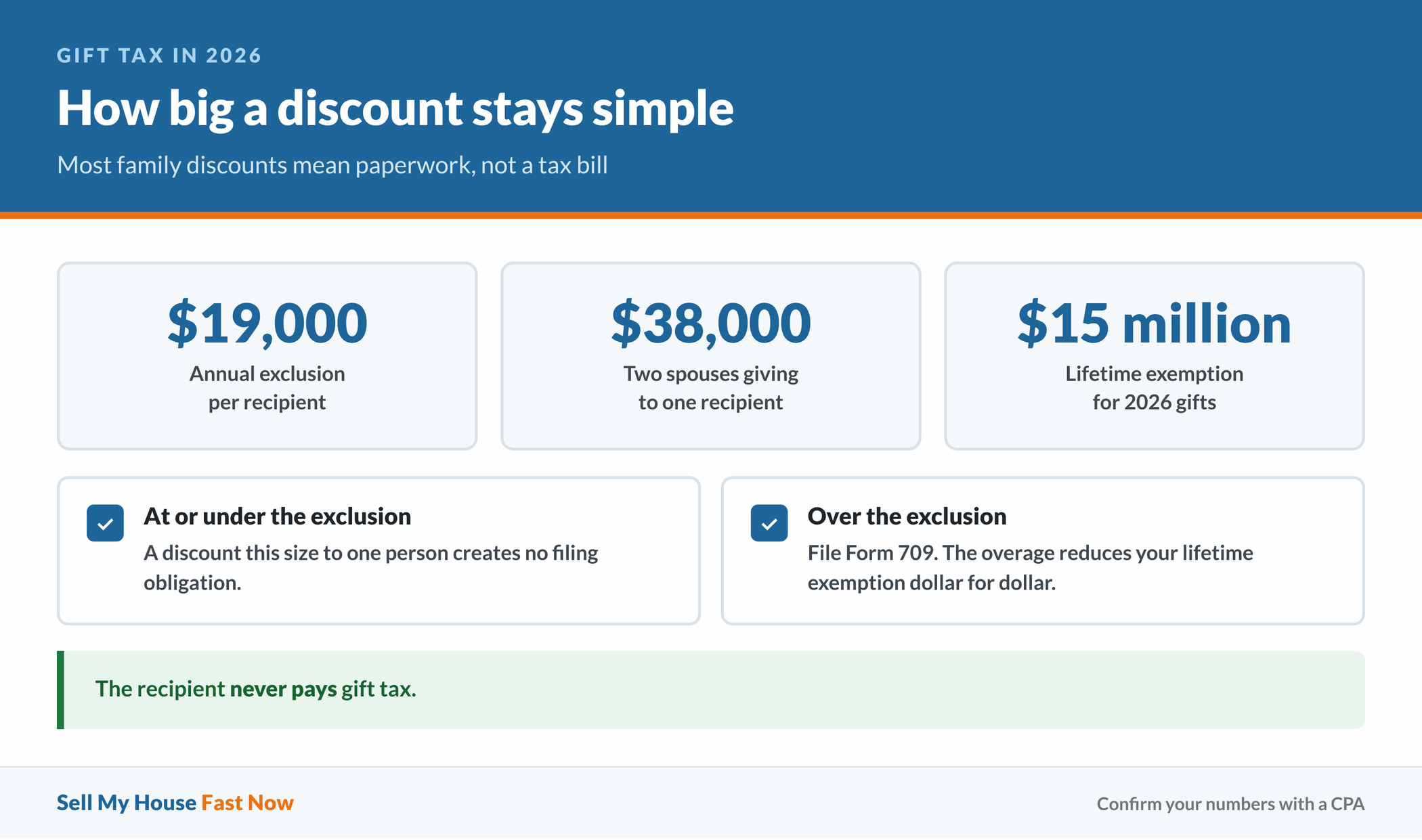
Nineteen thousand dollars is the number that governs the easy version. Under IRS rules for 2026, the annual exclusion is $19,000 per recipient. Sell below market value by that much or less to one family member, and you’ve got nothing to file at all. Go past it and a gift tax return enters the picture, though a tax bill almost certainly doesn’t.
Married parents get more room. Two spouses can give a combined $38,000 per recipient in 2026. If your son is married and his spouse is buying with him, each parent can use an annual exclusion for each of them. Four separate exclusions can work on one sale.
Past those thresholds, the overage reduces your lifetime exemption instead of creating a tax bill. That basic exclusion amount sits at $15,000,000 for 2026 gifts under Public Law 119-21, and you can confirm it on the IRS gift tax FAQ page. Very few families will ever touch that ceiling.
Pull three recent sold comps within a mile and adjust for condition before you decide how far below market value to go.
One caution I give every parent concerns a house that still carries a mortgage. Whatever price you choose, the loan has to be paid off at closing. Will the discounted price cover the payoff? If not, the sale stalls. I’ve seen that math surprise sellers who assumed equity they’d already borrowed against.
What Counts as a Gift of Equity to a Family Member?
Say the appraisal comes in at $400,000 and you sell to your son at $320,000. Selling below market value that way creates an $80,000 gift of equity, and it gets documented as one at closing. Many loan programs let that spread count toward his down payment and closing costs. He may bring little cash of his own, and you walk away with less at closing.

Lenders take this paperwork seriously. A gift of equity letter, signed by you, typically states the amount, the relationship, and that repayment isn’t expected, because lenders want that intent spelled out in writing. The appraisal has to support the value, and the settlement statement should show the credit clearly.
Conventional and FHA financing both permit gifts of equity from relatives, each with its own rules about paperwork and occupancy. Your son’s lender will spell out the exact rules for his loan type; those guidelines change often enough that I don’t quote them from memory.
A gift of equity doesn’t erase the gift tax reporting question. One sale below market value gets described two ways: the lender calls the spread equity, and the IRS calls it a gift to a family member.
Watch the timing as well. A family member who takes more than four months to close a conventional loan will need the appraisal updated. If the value moves, so does your documented gift.
Should I Just Sell to My Son at Fair Market Value Instead?
A full-price sale between relatives gets the same disclosure and appraisal scrutiny from lenders as a discounted one, because the non-arm’s-length label attaches to the relationship. Skipping the discount simplifies your tax filings. His underwriting stays the same.
Selling at full market value to a family member still solves real problems. There’s no gift tax return and no dent in your lifetime exemption. Plus, your son takes a basis equal to what he paid, which protects him when he later sells.
Cash flow is the argument against it. A son who can qualify for a full-price mortgage usually doesn’t need help from his parents in the first place. Families reach for a sale below market value because the gap between income and prices is real. Pending home sales fell 4.7% from September to October 2026, a record low in data going back to 2001. Affordability pressure is a big part of why.
My preference sits between the two: sell at market value and give cash separately for the down payment. You keep a clean sale price on record, and your son’s basis matches the full value. The cash gift gets reported on its own terms.
Some parents would rather keep family dynamics out of the sale entirely. They sell the house to a direct buyer such as Sell My House Fast Now and skip the appraisal gymnastics. Their kid gets a cash gift afterward with no strings attached.
Can I Finance the Sale to My Son with a Family Loan?
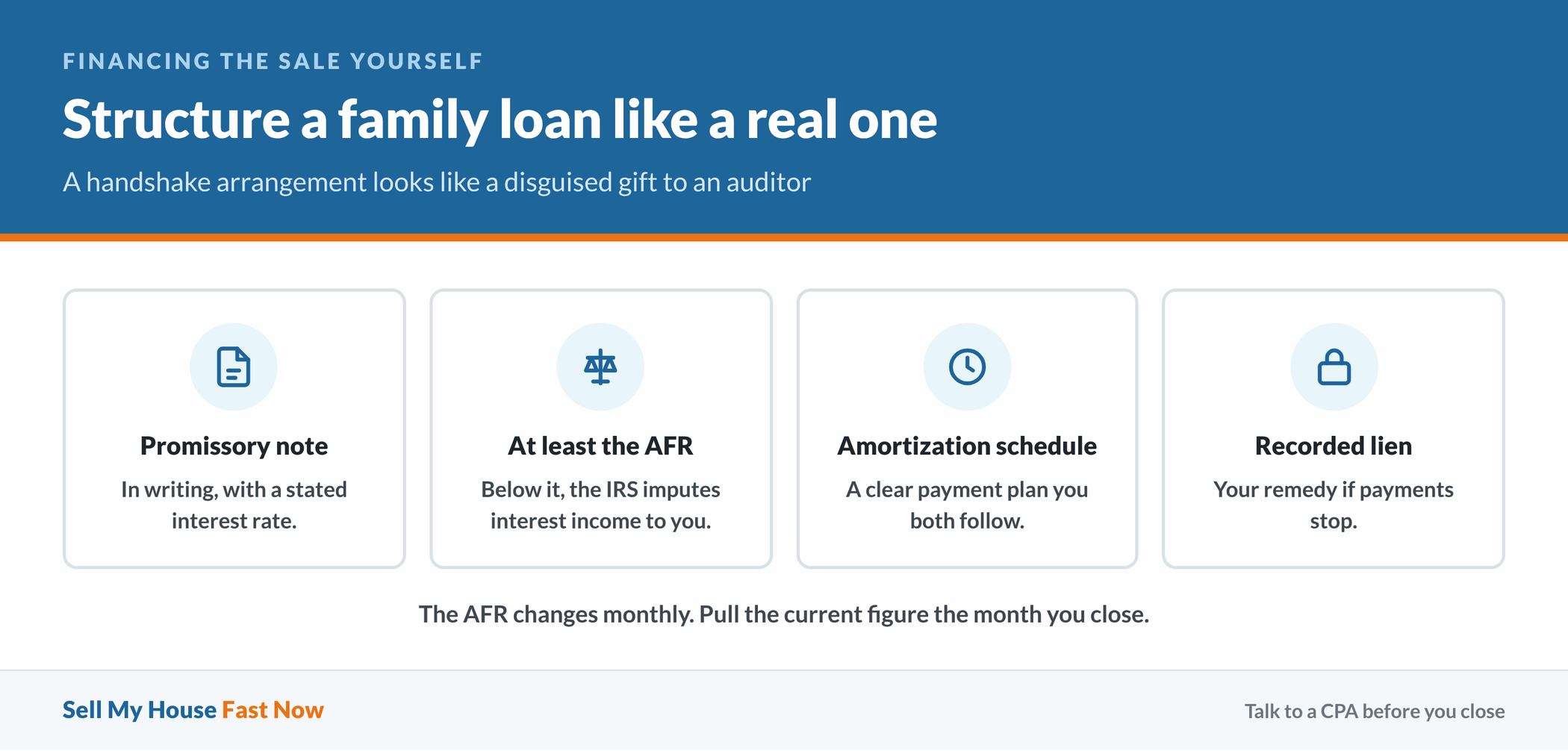
Seller financing is legal across the country, and plenty of parents carry the note for a child. You do have to charge at least a minimum interest rate, so a loan priced below the applicable federal rate counts as a below-market loan. Any gap gets treated as imputed interest, and you report it as income even though no cash arrived.
The AFR changes monthly and varies by loan term, so pull the current figure from the IRS the month you close instead of a number someone quoted last year.
Structure the loan like a real one. Put it in a written promissory note with a stated rate and an amortization schedule, then record a lien against the property. A handshake arrangement with a family member looks like a disguised gift to an auditor. It also leaves you with no remedy if payments stop.
Many parents combine approaches. They sell below market value by no more than the annual exclusion, use seller financing at the AFR for the balance, and forgive some principal each year as an additional gift. Each year’s forgiveness has to be documented and truly treated as forgiveness, not a wink.
Some families handle that fine. Others shouldn’t try.
Will Selling Below Market Value Trigger IRS Reporting?
Miss the filing and you’ve left an unreported gift sitting in your tax history, which can surface during an estate audit when nobody’s around to explain it.
Form 709 is the gift tax return. It’s due by the regular income tax deadline in the year after the gift, normally April 15. Filing it doesn’t mean paying tax. Gifts above the annual exclusion reduce your lifetime exemption dollar for dollar. Gift tax only comes due once your total taxable gifts pass the exemption amount.
As the recipient, your son generally won’t owe it either, because the IRS puts that duty on the donor.
Good records are your friend here. Keep the appraisal, the settlement statement and the gift letter together in one folder, along with any emails about why you sold below market value. If a question arises eight years later, that folder is your answer.

The gift equals the appraised value minus what your son actually paid. If the IRS ever looks, it’ll use a value it trusts instead of your number.
When the house is titled to one parent, a married couple can elect gift splitting on Form 709 so the gift to your family member counts as half from each spouse. That election is made on the return with the other spouse’s signed consent, and it doesn’t happen automatically.
Connecticut is the only state with its own gift tax, and it can reach Connecticut real estate even when the owner lives elsewhere. Texas, by comparison, does not impose a separate state gift tax, so transferring Texas real estate as a gift generally does not trigger Texas gift tax. However, federal gift tax rules may still apply in either state. A CPA licensed in your state can confirm what applies before you sign anything.
Who Pays Capital Gains When Selling to a Family Member?
Use the sale price from the example above with a $180,000 basis, and your gain is $140,000 whatever the house appraised for. Capital gains get calculated on what you receive when you sell below market value, so the gift portion isn’t income to you. It never hits your return as proceeds.
For most parents selling a longtime home, the primary residence exclusion wipes the gain out anyway. Section 121 lets you exclude up to $250,000 of gain as a single filer or $500,000 married filing jointly on the sale of your principal residence. You qualify if you owned and lived in the home for at least two of the five years before the sale. The IRS Section 121 guidance covers the partial-exclusion situations too.
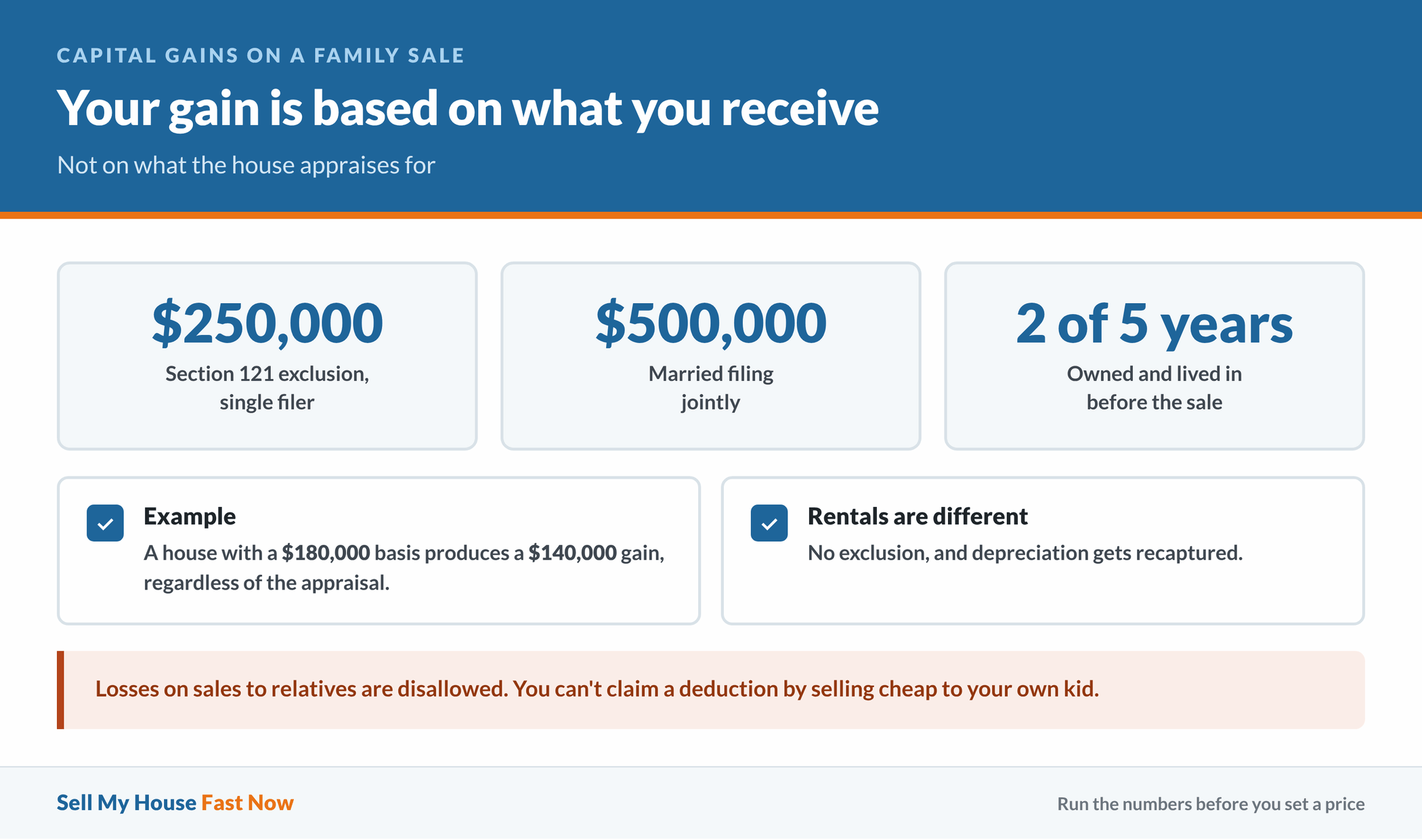
Rental property is the exception that bites. No exclusion applies, and depreciation gets recaptured. Selling a rental to a family member at a discount can produce a tax bill larger than the cash you walked away with. Run that math before you set a price on a rental.
Selling at a loss to your own kid won’t produce a deduction either, because the tax code disallows losses on sales to close relatives.
One pattern I keep seeing is parents who inherited the house themselves. Their basis stepped up to its value when the prior owner died, so a later sale to a child at or below that value left them owing nothing. Inherited property often carries far less gain than people fear.
Frequently Asked Questions About Selling a House to a Family Member Below Market Value
Can I Sell My House to My Kids for Less Than Market Value?
You can, and the transaction is perfectly legal in every state. What changes is the paperwork, since selling below market value counts as a gift from you to your child. You may need to file a gift tax return even though a tax payment is unlikely. Your child’s lender will also want written proof of the relationship and a supporting appraisal before it approves the loan.
What Are the IRS Rules for Selling Property to Family Members?
Three rules do most of the work. Any discount below fair market value counts as a gift and follows the gift tax reporting system described earlier. Seller financing has to carry at least the minimum federal interest rate or the IRS will impute interest income to you. And as covered above, a loss on a sale to your own child isn’t deductible.
Does My Son Have to Live in the House for the Discount to Be Allowed?
The IRS doesn’t require it, but his lender might. Occupancy shapes loan terms, down payment minimums and interest rates, and Fannie Mae allows a gift of equity from a family member only on a primary residence or second home. Tell the loan officer his actual plans for the house early, because a change in occupancy after closing can violate the mortgage terms he signed.
What If My Family Member Can’t Qualify for a Mortgage at All?
Then you’re looking at seller financing or an outright gift, both covered above. A third option is selling the property outright and gifting your child cash toward a home they choose. If the house is in North Texas, we buy houses in Dallas as-is, so the cash for that gift can come from a quick sale. That keeps the sale clean and keeps your retirement from riding on one piece of real estate. It also lets your family member shop for a house that fits their life.
If you’re weighing a family sale against just selling the house and dividing the money, we’re glad to talk it through with you. I’d rather point you toward an estate attorney than push a sale that doesn’t fit, and plenty of the calls we take end exactly that way. Reach out to Sell My House Fast Now when you want a straight number on what the property is worth as-is. No pressure, no obligation, and no hard feelings if you decide keeping it in the family is the right call.
Talk Through Your Family Sale Options With Us
Weighing a discounted sale to a relative against a straight sale? Contact Sell My House Fast Now and tell us a little about the house. We’ll share a cash offer you can set beside the appraisal. Use the form below whenever you’re ready.