
A landlord called me last spring about a duplex he’d owned since the Clinton administration. He figured he’d walk away with every dollar of his profit. Then his accountant brought up depreciation recapture, and the number on the page dropped by roughly a third. That phone call is the reason this article exists. If you want to sell rental property in Texas without paying taxes you don’t legitimately owe, you have to know which taxes are optional and which ones aren’t.
What Taxes Do You Owe When You Sell Rental Property in Texas?
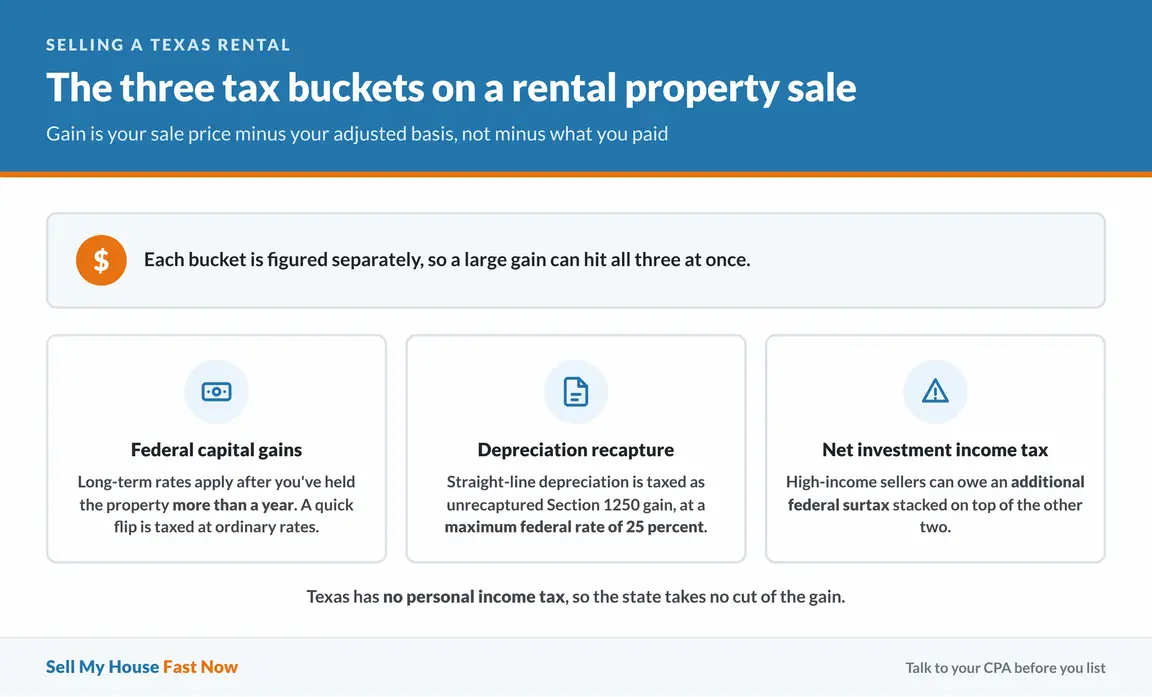
Pull up a chair, because there are three buckets here, not one. Federal capital gains fills the first bucket. Depreciation recapture fills the second, and it’s the one that surprises longtime landlords. Net investment income tax can land in the third if your income runs high enough.
Gain isn’t your sale price minus what you paid. It’s your sale price minus your adjusted basis, and that basis has been shrinking every year you claimed depreciation on the rental property. A roof replacement, a new HVAC system, the foundation work half of Houston seems to need: those capital improvements push your basis back up. Repainting a bedroom between tenants doesn’t.
Holding period changes the math, too. A rental property held more than a year gets long-term treatment. Flip one quickly and it gets taxed at ordinary rates, which are higher for almost everyone.
I see one move from Texas investors all the time. They count the equity on the closing statement and start spending it in their heads before anyone’s run the gain calculation. A Texas seller with a 20-year-old rental can owe more than a seller with a bigger profit on a place bought three years ago. Depreciation is doing its work there.
Selling costs work in your favor. Agent commissions, title fees and other closing costs reduce the amount you’re taxed on. So keep every invoice from the sale itself, not just the ones from your years of ownership.
Does Texas Charge State Taxes When You Sell a Rental Property?
Zero. Texas has no personal income tax, so there’s no state capital gains rate to plan around. An investor in Austin selling a four-plex pays federal tax on the gain, and the state takes no cut of that profit.
What Texas takes instead is property tax, and it takes plenty. Local tax rates here run well above the national average, and that’s the trade-off for the missing income tax. If you’ve been holding a rental property in a fast-appraising area, you’ve felt it in your escrow payments every year.
Market timing deserves more weight than landlords usually give it. Statewide, the median sale price in Texas was $330,000 in August 2026, according to Texas A&M Real Estate Research Center data, down from $335,000 a year earlier. Austin fell harder, with the metro median landing at $404,802 in October 2026, down 6.9 percent year over year per the Central Texas Housing Report. A softer market can trim your sale price and your taxable gain at the same time, depending on where your rental property sits.
Do you know how long your listing would sit? Dallas-Fort Worth listings ran a 64-day median in October 2026, based on Realtor.com housing inventory data. Tenants, showings and a 1031 clock don’t mix well with that kind of timeline.
Early last year I bought a small rental from a young couple in Pflugerville who were done being landlords. They’d inherited the tenant along with the house, and the garage still had the previous owner’s lawn equipment in it. Repair calls had gone unanswered for months. Knowing the state of Texas wouldn’t add its own layer of tax to the sale made the decision easier for them.
How Does Depreciation Recapture Affect Selling Rental Property Without Paying Taxes?
Those yearly write-offs feel like free money while you own the place. Every year you deduct a slice of the building against your rental income, your taxable income drops, and nobody sends you a bill. Sale day is when the IRS settles up.
All that straight-line depreciation you claimed on the building gets pulled out of your gain and taxed separately as unrecaptured Section 1250 gain. Individual taxpayers pay a maximum federal rate of 25 percent on that layer, and if your ordinary rate sits below that ceiling, the lower rate applies instead. A tax research glossary lays out how the calculation splits the gain.
Worse, the IRS figures this on depreciation you were allowed to take, not just what you claimed. Skipping it on your Schedule E for a decade doesn’t spare you. It just means you paid more income tax along the way and still owe recapture at the end. This is an important consideration when selling a Texas apartment, especially if you have claimed depreciation for several years.
Cost segregation studies complicate this further. Accelerated depreciation on personal property components produces Section 1245 recapture, taxed at your ordinary rate, and that can run higher than the 1250 ceiling. Investors who ran aggressive cost seg on a Texas apartment building sometimes find the recapture harsher than they planned.
Can you escape recapture for good? One way exists for an owner who holds the rental property until death, since heirs receive a stepped-up basis. Short of that, a properly structured exchange defers it. Nothing else really does.
How Do You Sell Rental Property Without Paying Taxes in Texas?
Blow a deadline by one day and the whole deferral vanishes. No appeals, no hardship exception, no do-over. Those are the stakes on every strategy in this section, so read the mechanics before you sign a listing agreement anywhere in Texas.
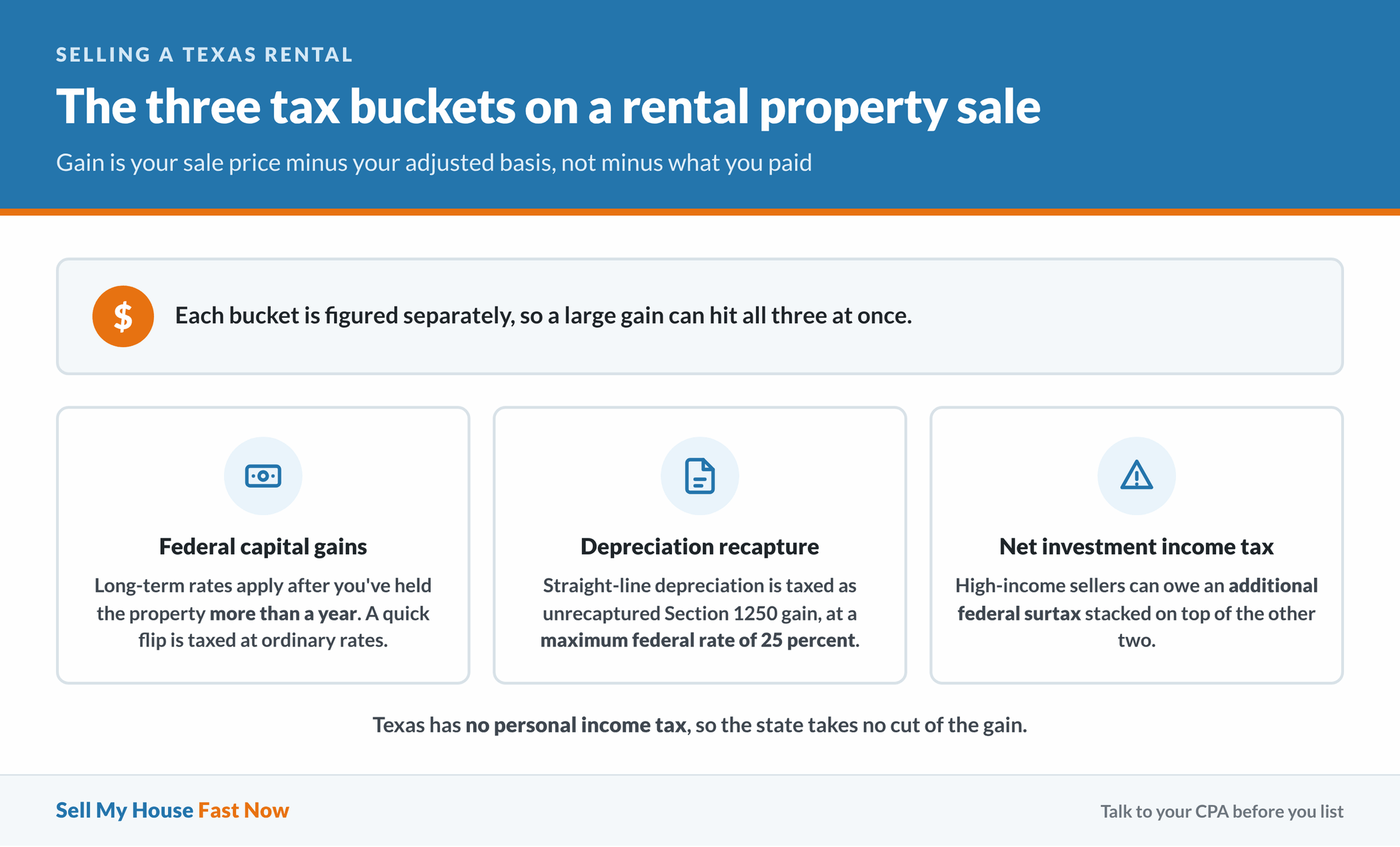
Four approaches genuinely work. A 1031 like-kind exchange defers the whole gain into your next rental property. Moving into the house as your primary residence opens up a partial federal exclusion. An installment sale spreads the gain across several tax years instead of stacking it into one. Holding until death hands your heirs a basis reset.
Offsetting is the quieter option. If another investment in your portfolio is sitting on a loss, selling it in the same tax year as your Texas rental property can shrink your net gain. Plenty of Texas real estate investors own one underperformer they’ve been avoiding for years.
One warning to take seriously: do not touch the sale proceeds if you plan to exchange. The money has to flow straight from the title company to a qualified intermediary. I’ve watched sellers wreck a deferral by having the closing check wired to their personal account first. No CPA can unwind that mistake afterward.
Your tenant situation shapes which option is realistic. A rental property with a month-to-month tenant can close fast. One with eighteen months left on a lease narrows your buyer pool to other investors, and slower Texas submarkets thin it further. When speed matters for a 1031 clock, selling to a direct buyer like Sell My House Fast Now takes the showings and the financing out of the picture.
Can a 1031 Exchange Help You Sell Rental Property Without Paying Taxes?
An investor in San Antonio sold a tired house he’d been leasing out and rolled the whole gain into a small retail strip near Loop 1604. He owed no federal tax that year, and his rental income roughly doubled.
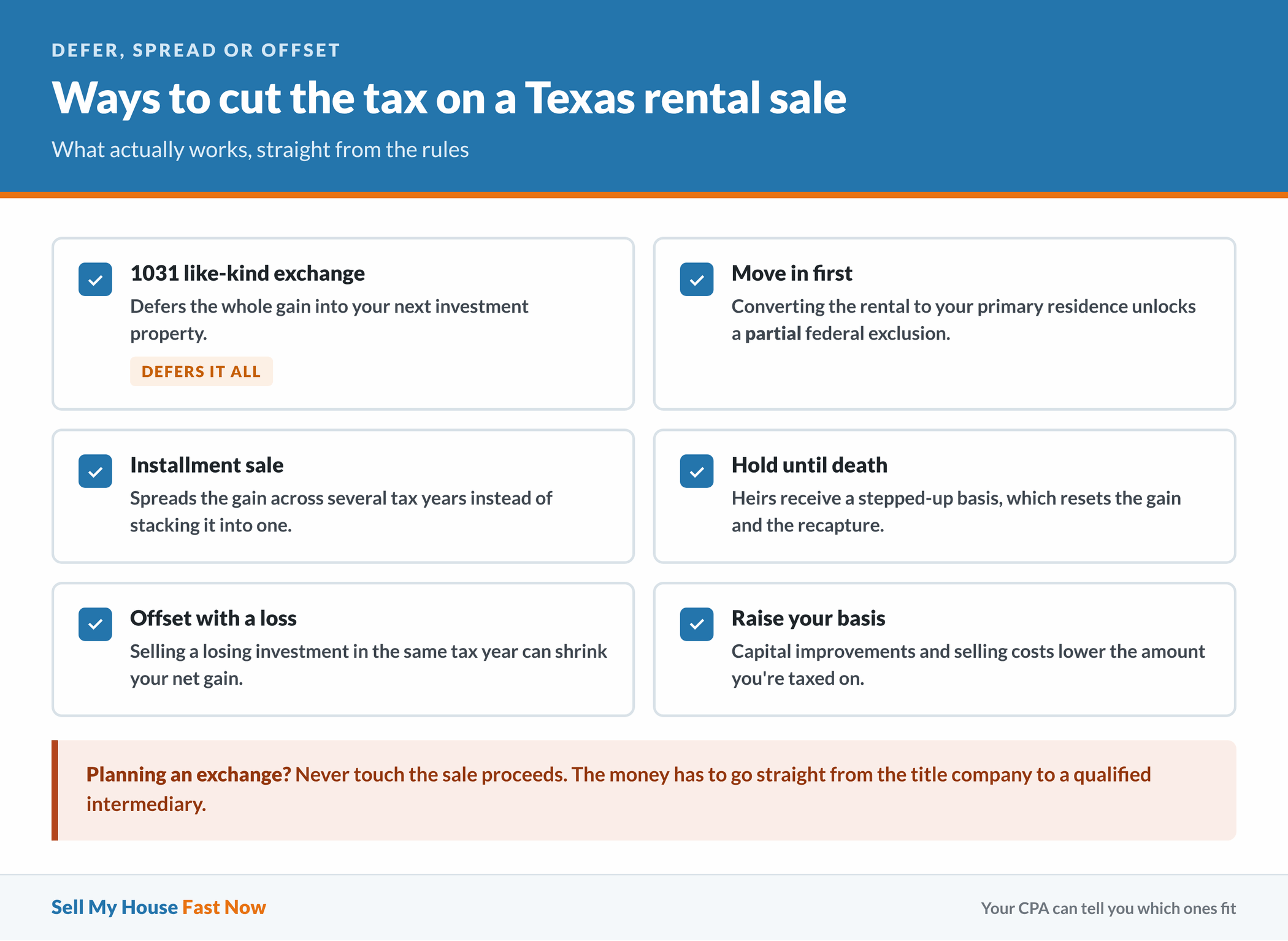
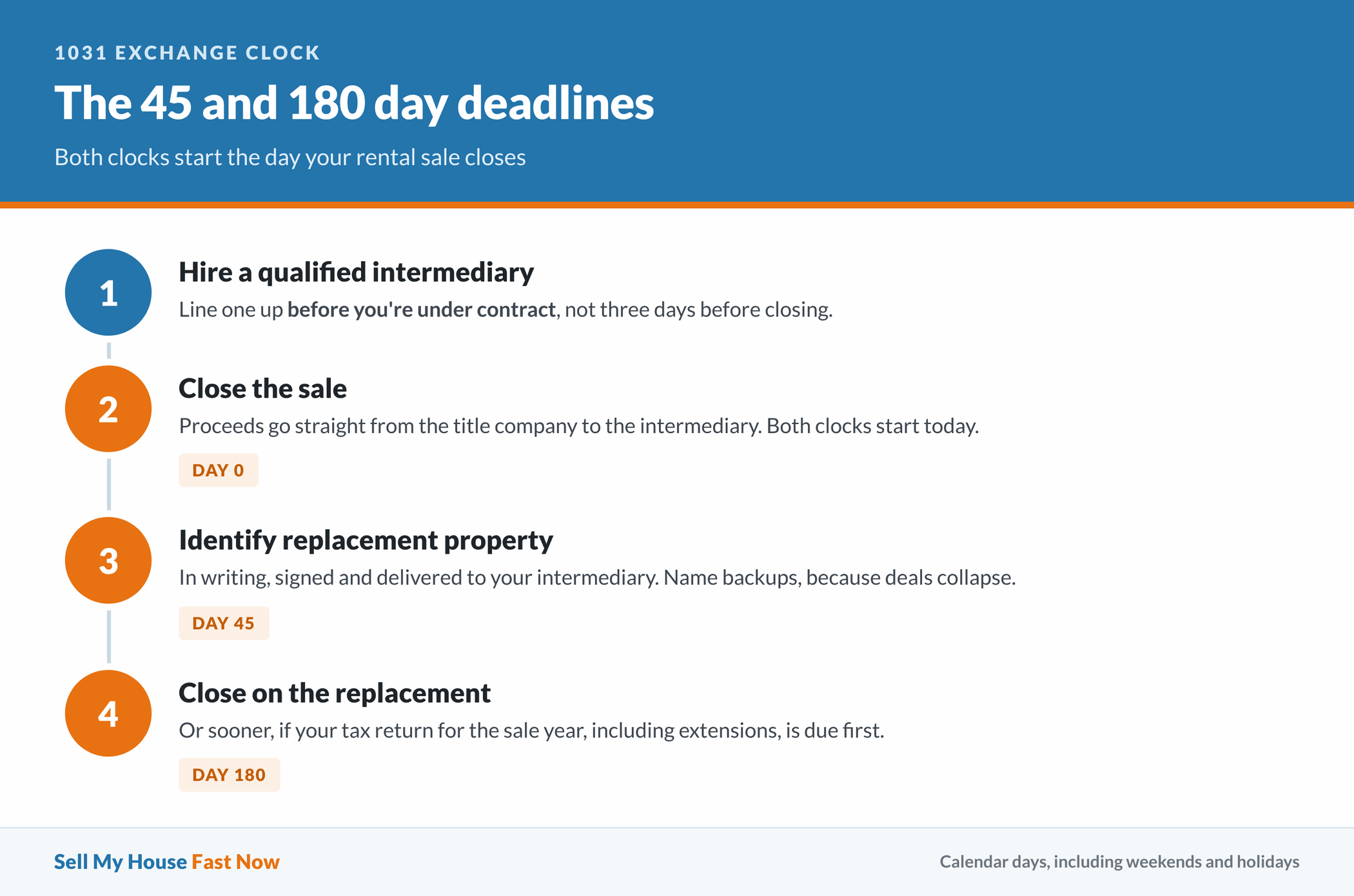
That’s the promise. The rules sound simple. The property has to be real estate held for business or investment, and you have to name a replacement within 45 days and close on it within 180 days. The sale money can’t pass through your hands at any point. Both clocks start the same day. The 180-day window ends sooner if your tax return for the sale year, including extensions, comes due first. This 1031 rules guide walks through the identification limits in detail.
Forty-five days is brutally short in a buyer’s market. Line it up against those Dallas-Fort Worth listing times and you can see the squeeze: your hunt for a replacement rental property has to start before your sale ever closes.
Your identification must be in writing, signed and delivered to your qualified intermediary. After Day 45, the identification list is final and can’t be changed. These are calendar days, weekends and holidays included.
Always name backup properties. The three-property rule exists because contracts collapse, and a seller who identifies only one replacement is one failed inspection away from a full tax bill.
Where exchanges fail in Texas is usually the intermediary. Hire one before you’re under contract, not three days before closing.
Can You Avoid Capital Gains Taxes by Converting Rental Property to a Primary Residence?
“I’ll just move in for two years and walk away clean.” Not quite, and the gap between that belief and the actual rule costs Texas landlords real money.
The federal home sale exclusion does apply to a converted rental property. Sellers can exclude up to $250,000 of gain, or $500,000 filing jointly, on a main home after meeting the two-year ownership and use tests within the five years before the sale. The catch is timing. Periods after January 1, 2009 when the house wasn’t your principal residence count as nonqualified use. The ratio of nonqualified months to total months of ownership carves out the part of the gain you can’t exclude.
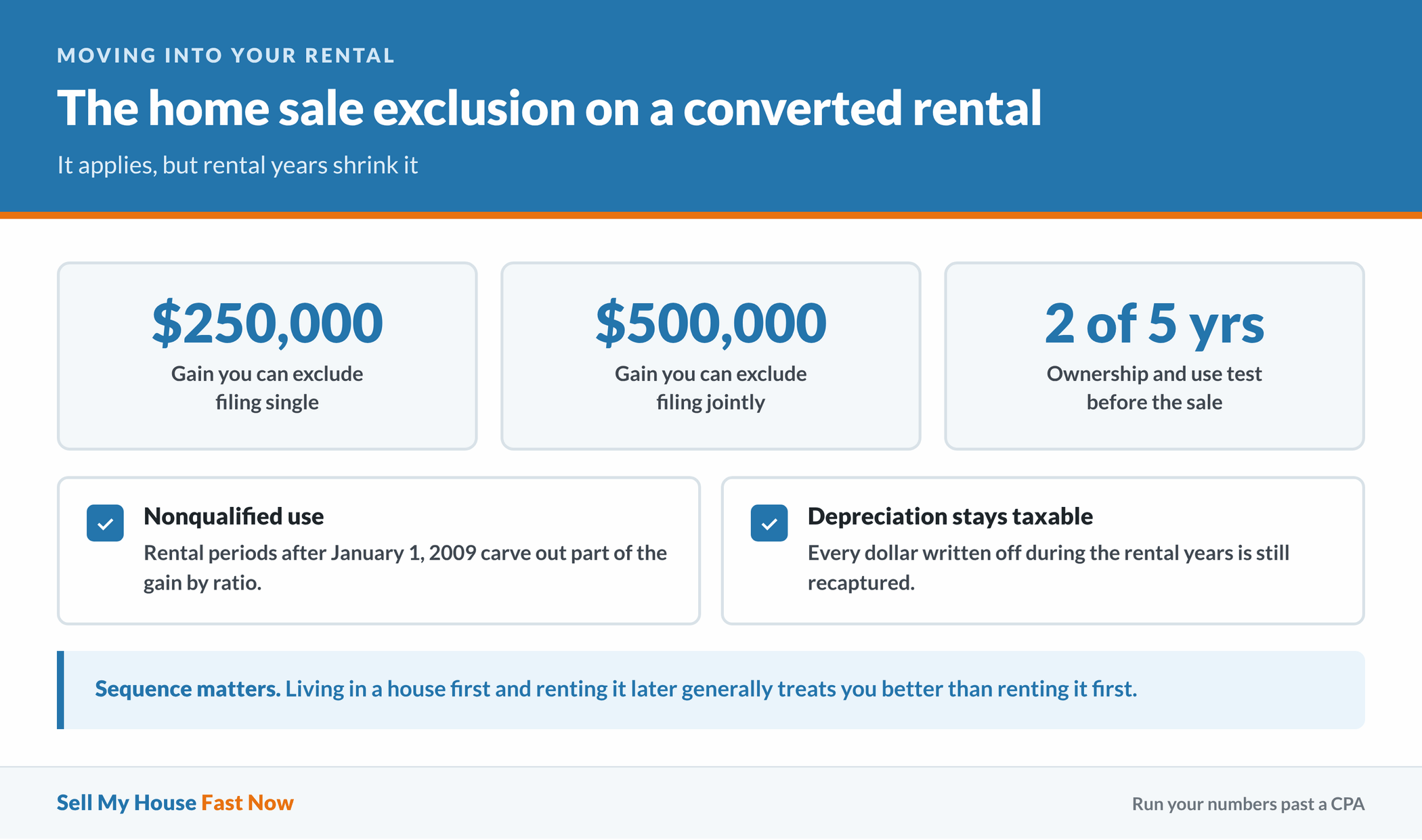
So a Texas rental you held for twelve years and lived in for two doesn’t get a clean exclusion. The rental years before you moved in drag a chunk of gain outside it. A plain-English breakdown of the exclusion shows the partial-exclusion math for converted rentals.
Depreciation survives all of it. Every dollar you wrote off during the rental years still gets taxed as recapture, exclusion or no exclusion. Plenty of owners build their plans around a number that was never available.
Would you really move your family into a rental house in Fort Worth or El Paso for two full years to save on taxes? For some sellers, the lifestyle fit is genuine and the savings are a bonus. Most people would end up with two years of life rearranged around a tax outcome that only partly materializes.
The order you do things in counts for more than how long you stay. Renting a house out after living in it generally treats you better than renting it first, and that’s a distinction to run past a CPA before you move a single box.
What Records Do You Need to Sell Rental Property Without Paying Taxes You Don’t Owe?
Thin paperwork shows up on the tax bill, and it usually shows up late. I’ve watched this play out with clients who were sure they’d kept enough records. A retired teacher in Lubbock sold a rental property she’d owned for 22 years and could document only what she originally paid. Her new roof, the foundation piers, the full kitchen remodel: all paid in cash, none of it on paper.
She paid tax on gain that wasn’t really gain. That’s the quiet cost of sloppy files, and it hits Texas investors harder than almost any audit ever does.
Keep your closing disclosure from when you bought the place, and hang onto every capital improvement receipt, every depreciation schedule and every Schedule E you’ve filed on the rental property. Permits from your city building department help prove improvements when receipts went missing years ago.
Hold onto the original appraisal too, for a different reason. Its land-versus-building split drives the depreciation figure. A seller who can show that split protects against the IRS assuming a larger building component and a larger recapture bill.
Partial-year rent, security deposits and prepaid rent all need clean accounting at closing. Prorated rent credited to a buyer isn’t your income, and the settlement statement should show that.
An heir I worked with in Beaumont had already watched two agent listings expire without a single offer on her late father’s rental house. The back bedroom still had his fishing rods stacked against the wall. She was paying taxes and insurance on a vacant house every month she waited.
Scanning everything into cloud storage costs nothing and takes an afternoon. Build the file now, because rebuilding 20 years of improvement records after you’re under contract is close to impossible. I’ve seen sellers scramble for old receipts mid-escrow, and it’s a rough spot to be in. When your paperwork is thin and holding costs keep climbing, a direct buyer such as Sell My House Fast Now can take the listing timeline off the table. Your CPA can sort out the rest in the meantime.
No Unnecessary Taxes When You Sell Rental Property in Texas
Net investment income tax is the line item landlords forget. High-income sellers can owe this extra federal surtax on investment gains, stacked on top of capital gains and recapture. Have your CPA price it out before you list the rental property.
You’re better off with realistic expectations than aggressive ones. A seller in Texas can defer, spread or offset the tax. Wiping it out usually takes either an exchange chain held until death or a genuine primary-residence conversion.
Texas gives real estate investors a structural advantage with no state income tax on the gain. Use it by planning the sale a year out, not a week out.
If you’re weighing a sale and want to talk through how the timing might work, we’re happy to have that conversation. Bring your questions, bring your numbers, and loop in your CPA. There’s no pressure here and no obligation to sell to us or anyone else.
Frequently Asked Questions About How to Sell Rental Property Without Paying Taxes in Texas
How Much Capital Gains Will I Owe When I Sell My Rental Property?
It depends on your holding period, your adjusted basis and your income bracket. Long-term federal rates apply if you held the rental property longer than a year, and the depreciation layer described above is figured separately at its own capped rate. Add your selling costs and capital improvements to your basis before you estimate anything, because those two items can shave five figures off the taxable gain.
Who Pays the Property Taxes When I Sell My Texas Rental?
You pay your share at closing. Texas property taxes are paid at the end of the year, and most counties accept payment as late as January 31 of the next year without a penalty. On a sale before October 1, the title company usually charges you from January 1 to your closing date and credits the buyer for that stretch. Check that line on your settlement statement. Your CPA can tell you how to report your share on that year’s Schedule E.
Do I Owe Net Investment Income Tax When I Sell My Texas Rental?
You might. It’s a 3.8 percent federal surtax, and it only applies once your modified adjusted gross income tops $200,000 as a single filer or $250,000 filing jointly. One large rental gain can push you past that line in the year you sell. An installment sale spreads the gain across several years, which can keep more of it under the threshold. Have your CPA run the numbers both ways before you list.
Do You Pay Tax on Rental Income in Texas?
Texas collects no personal income tax, so the state doesn’t touch your rental income. The IRS still wants its share, reported on Schedule E, where you offset gross rent with mortgage interest, insurance, repairs, management fees and depreciation. That depreciation deduction is the same one that comes back as recapture at sale, which is why clean annual records matter so much.
Can I Sell Rental Property Without Paying Taxes If I Reinvest the Money?
Reinvesting on your own doesn’t defer anything. It takes a properly structured like-kind exchange with a qualified intermediary, following the identification and closing windows covered earlier in this article. Depositing the proceeds and buying another Texas rental two months later is a fully taxable sale followed by a separate investment.
Does Selling to a Cash Buyer Change My Tax Outcome in Texas?
No. The IRS treats the gain the same whether a retail buyer finances the house or an investor pays cash. What changes is your timeline, and that matters if you’re racing an exchange deadline or carrying a vacant house through a slow season in your part of Texas.
Rental Property Sales in Dallas and Across Texas
Landlords across the city are selling into a softer market than they had a year ago. Zillow put the typical Dallas home value at $302,485 through October 2026, down 1.2% from the year before. If you own a rental property there, run your gain and recapture numbers before you set a price. We buy rental houses in Dallas with tenants still in place, and you won’t need to schedule a single showing.
Talk Through Your Texas Rental Sale With Us
Want a cash offer on your rental property before you decide anything? Contact Sell My House Fast Now with the address and a few details about the lease. We’ll walk you through the numbers, and you can take them to your CPA. Use the form below whenever you’re ready.
Helpful Texas Blog Articles